To Compete or Collaborate

Schools seem caught up in competition these days. When I was a student the competition was left for the sports fields and academic clubs like Chess Club, Quiz Bowl and Science Olympiad. These competitions promoted school spirit, pride and showed off student talents to the community. Competition is natural in between individuals, helping one strive to grow. This allows us to see if we are measuring up with others. Students feel pride with victory and return to practice hard in the face of defeat.

Now days schools are competing in more places. Since school of choice laws and for profit charters have popped up on every corner schools are competing for students, funding, rankings and staff. This competition is different than before, not friendly or for local pride but for survival. Similar to two rival businesses competing for consumers dollars. Is this new type of competition good for education?

District rush to be the first with a technology tool to market to students, many have forgotten to train staff and research best proposals. Money is spent on radio, billboard and television adds to lure students into choosing their school. Crafty vision statements and names have been used to make one school seem better than another. Wealthy district lure poorer districts top staff away by marginal increases in pay but hope for a future. It seems like we are running education like a highly competitive business.

Shouldn’t districts be collaborating? The majority of school funding comes from state school aid. All schools have the same goal to educate all students that walk through the doors. Should districts valuable financial resources be spent in competition as teachers re-create lessons that are being taught through-out the state? Wouldn’t we all be better served if lesson plans were shared. Instead of districts spend time creating their own PD each district could share their expertise with each other. Students would stay put, building strong schools in every community instead of leaving some districts abandoned.

Let’s make all schools succeed through district collaboration, leaving the competitions to the sports fields.

The Real Choice in School of Choice

choice

School of choice is a hot topic in political venues these days. From a teaching perspective it is cannibalizing our public education system. Student populations can swing drastically from year to year as districts spend money on marketing campaigns instead of in the classrooms. Creating unstable budgets and high teacher turnovers all in the name of choice. Recent studies in Michigan show that more than half of the school of choice students end up moving again. Is school of choice making the best educational system for ALL of our students?

Wasn’t a choice already made

Most parents make their school choice when deciding where to live. Real Estate brokers use the public school systems to market homes, apartment complexes proudly advertise the district where residents attend. Every friend I know took the public school system into consideration when choosing where to live. The decision is predominately made based upon test data and state ranking date. Do these numbers tell the true story of a school? No always, so of course many make a drive by of the community school to make a visual assessment and talk to parents who have children in the schools. After all this research housing choice is made that doubles as a school choice. As a resident of the community, parents will have a vested interest in maintaining quality schools.

 What if the community changes and schools slip? or Parents can afford to live where they really want to?

The REAL choice

Schools need parent involvement. Parents can’t just expect a district to have top-notch everything. They need to make the CHOICE to get involve in the school not abandon it. Communities need to rally around their school, asking what they can do to make student achievement happen. Instead school of choice has created a “its not problem, I will go elsewhere” attitude. Schools need parents in every aspect of the education process. From being on PTA to sitting on the district improvement team. Parents can coach sports teams, be hall monitors, and volunteer in the classroom.

It makes me sick when I see school of choice ads. Money that should be spent on students and learning is wasted to sell the dream that the grass is greener on the other side of the tracks. Pretty much same school just different zip code. Parents need to stop buying into this fade. Legislators need to end the concept as it exists today. Choice should be more about instructional practices not social economics.

Sometimes we need a PUSH!

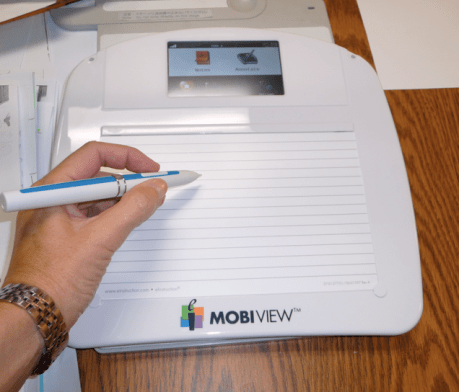
This week I received an e-mail from a colleague asking for help with a technology in her classroom. Being in a small district without funding for any full time instruction technologists to assist teachers requests like this happen frequently. I am seen as a person who either knows how to use a tool or get find out quickly. I am always glad to help a fellow teacher use new tools in their classroom. During my next free prep, I headed down to my colleague’s classroom. She had received some Mobi Views last spring and wanted to know how to use them with he students.


I had seen the Mobi’s demonstrated a few years back. We together we turned the units on. It took a few attempts to figure out what we were doing. At first it was awkward, figuring out the new tool. I model how to fail using the tool at the first few attempts. Eventually, I had it figured out so I could explain how to use to the other teacher. She fumbled around for a minute like I did and then was able to complete some simple tasks. As the prep period ended she was feeling confident in the using the Mobi for simple tasks. She sent an e-mail thanking me for the help, also asking how I might integrate the tool into lessons for her special needs students.

I had a few ideas, but by no means am an expert. I took a quick search of YouTube, found a few quality examples of teachers using Mobi’s in their classroom to send back to her. The next day she responded:

“Why didn’t I think of checking YouTube? I guess I just needed a push. Thank you!”

Sometimes all we need is a push in the right direction to get moving. It might lead to greatness.

Reflective Teacher Challenge Day 10 – Countdown

Day 10- @TeachThough 30 day reflective teaching blog challenge 

Share five random facts about yourself.

Share four things from your bucket list.

Share three things that you hope for this year, as a “person” or an educator.

Share two things that have made you laugh or cry as an educator.

Share one thing you wish more people knew about you.

5- Random facts:

1. I went to a boarding school in Connecticut.

2. I went to school with Seth MacFarlane.

3. I own 3% of a microbrewery some friends from college started.

4. I am a survivor of an airplane accident

5. I was always told I would make a great teacher but took two trips to college and 10 years to figure out my passion.


4- Bucket List Items

1. Go to Rose Bowl

2. Sail across an ocean.

3. See an elephant in the wild.

4. Explore the Galapagos Islands.


3- Hopes for the year

1. Peace in the world- Don’t we all hope for this?

2. Reach my students, make those connections, see success.

3. A mild winter: Last year was brutal!

2- Things that make me CRY

1- How society views education and educators. Needs to be valued MORE than entertainment.

2. Poverty and its effects on my students. Richest country in the world needs to be more compassionate and caring for others.

1- THING

1. I CARE about education, my profession, my kids!

Why Do I Teach?

I was pursuing twitter this morning, following all the wonderful Michigan conferences that I am missing, when I ran across a tweet from my friend, Michael Medvinsky. Michael was at home following the #zetacon hashtag, when he was inspired to act by writing a blog post and recording a video. Kevin Honeycutt was delivering the Keynote at Zetacon and asked “Why do you teach?” This is a very important questions for educators. Most of the time we share ideas about how we teach. Most conference focus on Pedagogy and “best practices”. Rarely do we hear teachers share their WHYS for teaching. Often without knowing why people do what they do we have a disconnect and fail to appreciate their work.

I know the why is often a long complex story. It is never the public assumption as to why teachers teach. “Teachers teach for the summers off, the benefits and 9-3 jobs.” Teachers need to share their WHYS so we get past the assumptions and focus on the reality. As schools across the country kick off the 2014-2015 school year teachers need to reflect on why we teach. I would like to say want to inspire and change the world, but there is so much more to why I teach. Here is a short video I made:

I know I missed some of my great inspirational teachers especially Jack Ridl from Hope College.

Please reflect on WHY you teach. I hope you can share your story with me by either posting a comment on the blog or creating your own video on using the hashtag #iTeach on twitter.

Have a great 2014-2015 school year. Always remember WHY you are doing what you do. Thanks Kevin and Michael for the inspirational reminder.

#michED – more than just a twitter chat

“So, I don’t do twitter, I can’t be part of #michED.” This is a statement I recently heard from a teacher when asking me about my T -shirt. Huge misconception. Yes, #michED has a twitter chat, Wednesdays from 8-9 pm, but it is SO much more. The twitter chat is just the gateway to connections that #michED community brings. The community is about connecting educators from all over Michigan to share the positives in education. The community includes anyone who wants to help promote great teaching and learning in OUR public schools.

The #michED community began at EdcampGR 2012 out of a discussion on how to connect state educators. Out of one discussion a twitter chat was born to connect educators and share ideas. As the active participants grew, the #michED podcasts were born. The podcasts highlight creative instructional practices found through out the state. Brad Wilson has done an incredible job capturing teaching practices in the state. Over the past year #michED has grown by fostering an environment of POSITIVE EDUCATION. Members of the community have presented at state and national conferences. Teachers meet in person to discuss our practice. Teachers collaborate online to make incredible learning opportunities for their students. In May, #michED issued a challenge (3 actually) to all educators in the state:

Hundreds of educators participated. If you are an educator and want to focus on the positive things in education, the #michED community is for you. Michigan Teacher of the year Gary Abud JR. recently wrote about the community in the Detroit News. Twitter is just a tool many of us use to connect over the many miles of this state. If you want to learn how to use twitter to connect to the community here is a great starting point. If twitter isn’t for you it does not mean you can’t be apart of #michED. The community includes all educators from pre-K to college. Join us at Edcamps, conferences, on other social media platforms. Be apart of the positive change we can make in education in the state of Michigan and beyond!! Look for ways to connect with other like minded educators.

I, like all educators in the #michED community, look forward to making the connection with you! Whether it is face to face or via social media. Lets make a better education environment for teachers and students alike, by focusing on the positive change we can make!