I was pursuing twitter this morning, following all the wonderful Michigan conferences that I am missing, when I ran across a tweet from my friend, Michael Medvinsky. Michael was at home following the #zetacon hashtag, when he was inspired to act by writing a blog post and recording a video. Kevin Honeycutt was delivering the Keynote at Zetacon and asked “Why do you teach?” This is a very important questions for educators. Most of the time we share ideas about how we teach. Most conference focus on Pedagogy and “best practices”. Rarely do we hear teachers share their WHYS for teaching. Often without knowing why people do what they do we have a disconnect and fail to appreciate their work.
I know the why is often a long complex story. It is never the public assumption as to why teachers teach. “Teachers teach for the summers off, the benefits and 9-3 jobs.” Teachers need to share their WHYS so we get past the assumptions and focus on the reality. As schools across the country kick off the 2014-2015 school year teachers need to reflect on why we teach. I would like to say want to inspire and change the world, but there is so much more to why I teach. Here is a short video I made:
I know I missed some of my great inspirational teachers especially Jack Ridl from Hope College.
Please reflect on WHY you teach. I hope you can share your story with me by either posting a comment on the blog or creating your own video on using the hashtag #iTeach on twitter.
Have a great 2014-2015 school year. Always remember WHY you are doing what you do. Thanks Kevin and Michael for the inspirational reminder.
Over the past few weeks I have been thinking about educational training and a perceived disconnect in education between pre-service teacher education programs and teachers on the job working in school districts.
It all started when I was attending #COLChat2Action conference, when I saw a tweet asking why College of Education professors were not in attendance getting the same “training” service teachers were recieving. After thinking for a few minutes, rarely have I run into college professor in the same training sessions as in-service teachers. I know Troy Hicks and David Coffey are two incredible professors who I have run into many times at teacher training sessions as presenters and attendees. Are they the exception to the rule?
A bit latter I was sitting by Lisa Madden, a curriculum consultant for the Genesee County Intermediate School District, who felt there was a general disconnect between schools of education and school districts. Obviously some professors work hand in hand with districts but overall entire colleges of education don’t. Lisa reflected that intermediate school districts often feel like remediation programs for schools of education, retraining teachers who learned and practiced “bad” habits.
This week I read Tom Whitby’s post: “The Two Worlds of Education“, which made me think more about this issue. Maybe there are “Three worlds of education”: connected educators, unconnected educators and those in educational programs. As I reflect on my own educational experience, I feel that many of the practical day to day aspects of teaching were not addressed in my school of education program. I feel my program did the best they could but now I see a better path. Even if this is just a perceived disconnect, it needs to be cleared up.
Shouldn’t all of these educational worlds line up? Why aren’t university schools of education embedded into school districts? Pre-service teachers need to see the ins and outs of teaching. College professors need to stay “fresh” by being in the classroom regularly. Intermediate school districts could pool their resources with schools of education to provide the best “training”. All educators need to be on the same page since we all have the same goal:
In a world of casual Fridays, golf shirts and dressing down it is nice to see people dress up for a day!This week our school is having spirit week to help celebrate the year of learning. We have your typical school pride day, favorite sports team day, Grade color day etc, but Today we took things to the formal level. Dress to Impress Day or as I called it Dress for success.
Students and staff Dressed up! T-shirts and Hoodies gave way to nice dresses, coats and ties were seen all over the school. It impressed me. Student behavior seemed better. Students stated they felt good about themselves because they were getting compliments. The overall feeling in the building was that of pride! Of course not every student can participate. A few commented that they had “nothing” dressy to wear.
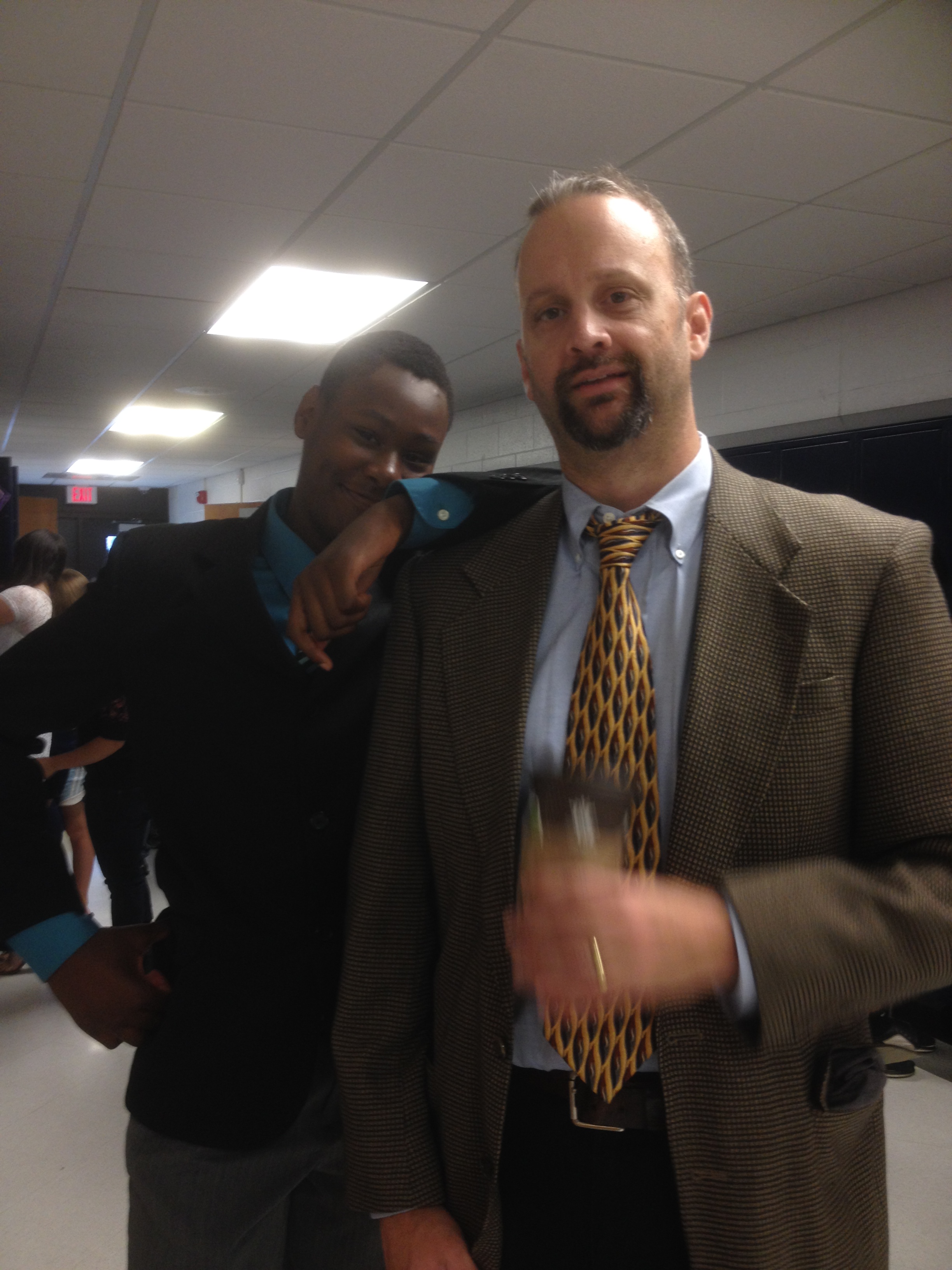
It was nice to see students take pride in their attire. Girls learned that heels are painful for their feet to wear all day. I took the time to help boys learn how to tie their ties. It felt great for me to get compliments for being dressed up, finally being called “professor” by a group of students. (My normal attire has me looking more like a golfer than a teacher.) Staff spent time modeling how to dress for success. I feel it was a very valuable experience for our students. Very different than the typical school spirit day.
A big thank you to our wonderful building staff for modeling how to dress for success! The student council and their leaders should get kudos for planning a day of modeling self-pride.
Next time your school is planning spirit week, place a positive day like “Dress for Success” next to wacky Wednesday and Sports Team Friday. You will be glad that you do!!
My district uses NWEA MAP scores to measure student growth. Our students take the test in the fall, are give a target to reach when they take the spring test. We have been using the Math and Reading tests for the past 3 years and this year we added the general science test. This week my classes took thescience test. We missed the growth target! One of my student growth data points will not be rated as effective. For me to have gotten effective 60% or more of my students needed to hit their growth target as projected by NWEA. We missed. I feel I have failed my class.
Or at least I did until:
A student took the 45 question test in 10 minutes and saw their test score jump 13 points!! Wait, What? I can’t read 45 questions in 10 minutes, That is answering a question about every 13 seconds is that possible with any accuracy? Yes, I know this student met their target, but it makes me question the validity of the test for every student. If someone can score higher by chance, can’t they also score lower? Should their be a way to make sure students actually read the test? Or is that one me monitoring 30+ students? (In fact this student tested 1 on 1 with another teacher because they we absent when the test was given) The fact is this student growth is reflected in MY teacher evaluation, it leaves me with a few questions.
1. Where do the growth targets come from? Not all students grow at the same rate so how in the world can NWEA project these targets? I have been told that they are calculated as the average growth for everyone that scores the same RIT score. IF so then 50% of ALL students will fall above and 50% will fall below as a law of averages.
2. What standards is the NWEA test based upon? I assume common core for ELA and Math, is it Next Gen for science? Surely not the Michigan 7th grade science standards that I am required to teach.
3. If students are above grade level, is it expected for them to grow? Teachers teach a grade level content standard, how can students grow in areas that are not taught as defined by curriculum? I know teachers need to offer enrichment opportunities in class but the dig deeper into curriculum not into high level curriculum that the NWEA test measures.
4. Do multiple choice test really measure knowledge? I often call them multiple guess tests. Most of my student love multiple choice because they can take a guess. They hate fill in the blank and short answer questions because that requires them to have the knowledge. I find it funny that a student who takes 30 minutes to try and unsuccessful complete a short answer test is done in 30 seconds with a similar multiple choice one! The new assessment for the common core are placing an emphasis on more open ended questions so why not NWEA?
5. Do these test scores correlate to content mastery? Is there evidence that doing will on MAP tests means students DO know the content knowledge?
I know these are changing times. Teachers are responsible for making sure our students grow. I KNOW every single student in my class grew in many different ways this year. I have their classwork to prove it. I hope the laws will be fixed so teachers like me don’t feel like FAILURES.
I will continue to strive to be the best teacher I can. I don’t want to resort to teaching to the NWEA (or any test) just to keep my job, I personally feel that would be educational malpractice.
This year I have had the pleasure of working with an MSU PHD candidate, who has come in to observe my teaching. He started observation a few years back as part of the Formative Assessment for Michigan Educators (FAME) project. Since that time his observations really focus on the what and how teachers teach. The following is the most recent transcript of his observations in my classroom, Names have been changes of my students, I found it cool to reflect on my teaching after reading his account of what happened.
4.21.14
When I walk into Todd’s second hour science class a scene from the movie Up is playing on the screen in the front of the room. “You’re going to see something that I talk a lot about,” Todd tells students from the doorway as they settle in. He also mentions that the class will not be watching the entire movie. Students just need to watch this scene so Todd can make his point.
After the scene is over, Todd stops the video and says that students should not be like the dogs in the movie who are constantly distracted from their pursuits because they see a squirrel. Todd asks students to think about the “squirrels” in their lives and suggests that these distractions could be a cell phone or other electronic devices.
“The cellphone is not going to help you do well in school,” Todd says. “don’t let the squirrel lead you out of where you need to be.”
Next, Todd introduces his three children briefly. Today is “Take your child to work day” and Todd has brought his three children to see what their dad does for a living.
Some of the students are engaged in animated talking and Todd calls for their attention. He explains to students that today is the final day of working on the research report that they started a week ago. He tells students that they should consider the rubric for the assignment and compare their work against the stated requirements of the rubric before they submit their final project. When Todd is finished with the explanations, he asks, “Does this make sense?”
No student raises a hand. “Yes? No? Maybe so?” Todd asks as he scans the room looking for hands.
“Maybe so,” one student in the middle of the room calls out.
Todd dismisses this comment and begins talking to students about another requirement of the assignment. Students have to complete a self-reflection after they have submitted their research project. This self-reflection asks students what grade they think they deserved and also requires them to justify this conclusion.
“And I don’t want ‘I deserve a good grade because I worked hard,’” Todd explains, “everybody worked hard. I want you to use the language of the rubric in your response.”
Todd next asks two students to help distribute laptops from the laptop cart. The two boys go to the back left side of the room to where the cart is located and begin to distribute laptops to the other students who have now gathered around the cart waiting for a laptop. The research projects varied but each was supposed to use digital media of some sort. Thus, each group of 2-3 students needed a laptop to complete the work. The laptops are quickly distributed and students return to their tables. Many students engage in social talk as they are waiting for their computers to boot up.
I decide to go to a back table (nearest to where the laptops were being distributed), and ask a boy, Chris, who is working by himself if he would mind if I sat and talked with him for a few minutes. He says yes and tells me that students were allowed to pick their own groups. I ask him if students were also allowed to work alone as he appears to be doing. However, Chris tells me that he is not working alone. He has a partner. He then points to his partner, Brad, who is standing up on the left side of the class between the front and the back of the room talking to a boy and two girls.
“I’m working with Brad,” Chris says.
“He’s not working, though,” I say.
Chris smiles but keeps working.
For his project, Chris has created a website on the human impact of the earth. As one scrolls down the page, Chris has recorded information about his topic “Humans Impact on the Earth” and found several pictures (using Google images) that would appropriately represent each of the facts that Chris included on his website.
I ask what work Chris has done and what work Brad has done. For Brad’s portion, Chris show me a picture and a one-sentence description.
“How long have you been working on this?” I ask.
Chris tells me that the class has been working on the project for about a week.
“So, in a week Brad has written a sentence and found an picture on Google Images to go with it?” I ask.
“Yeah,” Chris confirms, again with a smile and again without taking his eyes off his computer screen.
Momentarily, Brad wanders over, sits for a moment, fiddles with the computer and then leaves to talk to a girl at another table, where he promptly commandeers the girl’s I-phone and begins to manipulate the buttons.
A female student comes over to Chris and stands behind his right shoulder.
“Are you in my advisory?” the girl asks.
“No,” Chris answers without looking up from his computer.
“Are you sure because I think I’ve seen you before,” The girl continues.
Chris says nothing and the girl quickly flits away and continues to work with the two girls with whom she was working before.
Brad comes back and stands over Chris’s shoulder. “Chris, did you finish?” Brad asks.
“I’m almost done,” Chris answers. Again, he does not look up from his computer.
“Don’t play games!” Brad says, “Hurry up.” Brad blows a bubble and walks away.
A few minutes later, Todd walks by and Chris tells Todd that he needs him.
“How can I help you, Chris?” Todd asks.
Chris tells Todd that he is having trouble publishing his website. Todd angles the computer toward him and tells Chris a few things. Todd then leaves and walks to the adjacent table where his children are playing chess with students who are finished with their projects or are otherwise not currently working on them. Todd takes a picture and moves on to help students who need him.
“Brad!” Chris calls. Brad is now talking to a pair of girls near the checker game. At first Brad delays in coming over to where Chris is working, but eventually Brad makes his way over to where Chris is working.
“Did you finish?” Brad asks.
“I don’t know how to spell your last name,” Chris tells Brad. Brad sits down, angles the computer toward him, and types in his last name. Brad then gets up, walks to the other side of the class, and sits on the back counter next to friend. The two boys talk to a girl who is standing in front of them.
Momentarily, Brad comes back and Chris tells him that he has now published the website and the project is finished.
“You got it published?” Brad asks with enthusiasm, “Woo-hoo! We’re famous!” Brad gets up and leaves again.
Again, Todd walks by and Chris stops him to ask a question.
“Then we do the reflection?” Chris asks. Chris is asking about the self-reflection that students must complete electronically as part of the assignment.
“Yes, do the reflection,” Todd confirms.
Chris begins working through the reflection. I ask Chris if he is doing one for both him and Brad. Chris responds that he thinks every student must do his or her own reflection. Brad comes back after socializing for a few more minutes
“Did you finish?” Brad asks.
“Yeah, I’m doing the reflection,” Chris explains. He then tells Brad that he, too, will have to complete a reflection.
“Put me and you both in it,” Brad insists, but before he can leave again, Chris tells him that each student has to do his or her own.
“I’ll do my after,” Brad says looking over Chris’s shoulder at the computer screen.
Chris says, “to be honest, I think we deserve a B because we could have added more.”
Brad, still looking over Chris’s shoulder, says nothing. After a few seconds, Brad begins walking around the room again. This time he is clapping rhythmically (this lasts for about five beats).
Chris completes his self-reflection. Todd tells students that they should be submitting their work or preparing to submit their work. Brad returns and Chris tells Brad that he should complete the self-reflection. Chris has it all set up for Brad.
Brad sits at the computer and reads the screen. He then types responses to two of the questions in the self-reflection activity:
What grade do you deserve?
Brad’s response: A
Why do you deserve that grade?
Brad’s response: because I put all my effort into this that is why I think I
Deserve an A
Brad finishes and puts his computer back on the rack. Todd calls for all students to log off on their computers and to return them to the mobile lab as Brad has just done. In a moment, Todd continues.
“Can everybody get in their seats, please?” Todd asks. He is repeating, “Shh!” as many students continue to talk socially. “Alright, excuse me. I know we’re having trouble settling back down.” Todd then thanks individual students and coordinates the return of a few final computers. “If I could have your attention please so we can wrap up and you can go on time.” Todd explains that some of the students are done but that some need more time. He suggests that students who need more time work on this project during advisory. All students will be presenting their projects next week. Todd says that he heard a lot of good collaboration and question asking during the period.
“What was the point of the project?” Todd asks.
“To understand how humans affect the earth,” A student calls out.
“Alright to help us understand the earth with the things we do,” Todd says. He then
tells students that he wanted them to learn how students can make a positive impact on the environment.
“I want to go now!” Todd’s young son announces (remember, it is “take your child to work day”)
Nearly everybody in the class laughs (a good-natured laugh).
“He’s a squirrel,” one student suggests. The student is referring to the reference Todd made about the importance of focus.
I don’t catch Todd’s response but in any event he dismisses the students and they exit.
When I first started hearing about coding on Twitter, I was intrigued. I remember when I was in school learning how to use Basic programming. “If this then that… ” and Go to Line XX” statements bring back frustrating memories of the green screens. I at first figured I needed to take a class to figure out how to program myself, then learn to teach it, then bring it into my middle school classroom. After hearing a few elementary teachers talk about coding clubs and coding in their classrooms, I figured I needed to get up to speed with coding so my students could experience it. As I was checking out coding sites, I noticed that Code.org celebrated an anniversary and placed a version of the “flappy bird” came on their site. At the same time my 4th hour ten week “Maker” class was begging to try something new.
So, I took the plunge. I worked through the code.org activities at night, teaching them the next day. My students were instantly engaged. Eager to make their own games. Being a group of diverse learners, some were done in minutes, while others took all class period. All ended up making a game. The learning that was happening in the classroom was astounding. Students were asking each other meaningful questions, trying different lines of code, failing and then fixing the fail. They were proud to share their games with classmates.
Every seventh grade advisory class heard about our “games”. Students who took the class earlier in the year complained that they did not get to code. We continued through the lessons on code.org until the students wanted freedom to make something on their own instead of using prescribed codes. We have since moved on to Scratch, which allows the students more freedom to create animated scenes and games. I am barely ahead of the students, often having to model problem solving skills on the fly to help them find success. We are learning to code as a class. The class has experts who even I go to with questions, because they go home and “play” with code to produce their desired results. A few students aren’t as engaged but they still are learning how to figure out code.
If you haven’t tried coding with your students, you should do it! I saw learning in the rawest form. We were learning as a class. Everyone wanted to complete the task. I now have students who are not enrolled in the class but e-mailing in the assignments to show what they have learned by following the class tasks list. Coding has lead to more engagement in authentic learning for my students. They are coming to class wanting to see what they can learn each and every day.


![IMG_3308[1]](https://sweattoinspire.com/wp-content/uploads/2014/06/img_33081.jpg)
![IMG_3305[1]](https://sweattoinspire.com/wp-content/uploads/2014/06/img_33051.jpg)



![IMG_2915[1]](https://sweattoinspire.com/wp-content/uploads/2014/03/img_29151.jpg)

 Sweat to Inspire