Hacking School #mschat

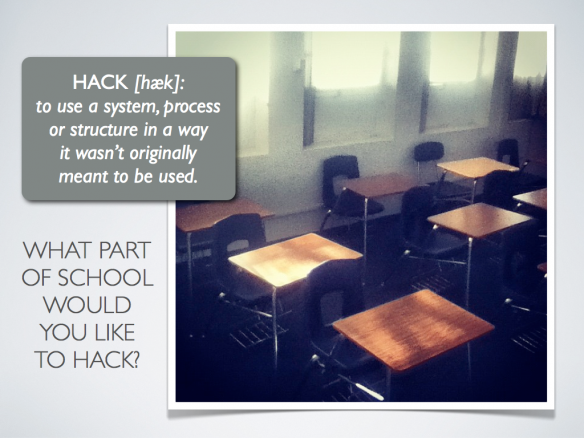
This week’s topic for #mschat is “hacking school!” Thursday May 9 at 8 pm ET.
From John T Spencer from here
The idea is not mine. Nicholas Provenzano, exposed me to the idea when he shared his visual writing prompts for blogging during the MACUL conference in March. Nick shared how he used this prompt with his high school English students. I felt it was a great way to hear the students voice.
Recently, I used the prompt with one of my classes. My middle school students loved the idea of “hacking” school. I shared my ideas about having flexible classrooms, 1:1 technology for students and more individualized instruction. My students took to blogging. I was anxious for the results.
Few of my middle school students took my lead for finding better ways to learn. Most students focused on different kinds of changes. Many wanted different food in the cafeteria. I totally agree here, but the food they desired to replace “school food” contained less nutritional content. Many wanted Taco Bell or McDonald’s to come in an cater. Some students desired vending machines with “pop and candy”. Change is needed for sure, more instruction in nutrition will be coming shortly.
As I moved past the “food changes”. Many post desired a change in the dress code, to no code at all. I asked, “What you want people showing up in underwear?” “NO!!” was the quick reply but students felt that nobody should control what they wear. Our school has a pretty lax dress code. I guess teachers need to share dress standards for different work environments.
Other students voiced their desire for a shorter school year, stating that more learning would occur. How this would be accomplished was not share. As I keep searching for hacks that would improve learning, I started to feel despair. Did my student feel their learning environments were satisfactory in our school? I feel changes could be made to improve learning, shouldn’t they?
As I dug deeper, I found specks of brilliance . One student wrote, “Schedules need to be flexible so student can choose the class order and lunch time based on desire and need.” Now that makes sense, why can’t it occur? Attendance and class size might be limiting factors but with work it can occur. Another talked about allowing students to use their technology for learning with a WiFi network. A student was clearly articulating a BYOD policy.
My students seemed focused on simple rule changes that might not make our school a better learning environment. Student voice is important to listen to when making changes. I feel that listening to it can also show educators knowledge deficits that need to be addressed in our students.
Teachers have seen education from many angles.I hope that by chatting with middle school educators about how to change schools. I can present a complete list of ideas before conquering this assignment with my students again.
If you have ideas about how to change schools to create better learning environments, please join #mschat on Thursday.

Layers of Atmosphere R.A.F.T. Writing

As we continue the study of weather in my classroom, Last week my students tackled the following assignment:

Learning Target: Understand layers of the atmosphere by writing a first person narrative.

R.A.F.T. Writing Atmosphere

R: Role– An experienced Space Shuttle Astronaut

A: Audience– The newbie on the flight

F: Format– Narrative

T: Topic – Describing what the newbie is seeing out the window as the space shuttle flies up through the layers of our atmosphere.

Assignment: You are to use the RAFT writing strategy to describe layers of the atmosphere. Give a vivid account of what of the layers of the atmosphere look like as you pass through them. Below is a checklist of what must be included in your descriptive  narrative.

  1. 4 –layers of the atmosphere
  2. At least 3– details about each layer
    1. Density
    2. Temperature
    3. Air pressure
    4. Composition
    5. Interaction with solar radiation
    6. Weather

3. 1 item you might see out the window in each layer

4.  At least 10 Content area words

5.Paragraph structure

6. Good transitions.

I felt this was a good way to have the students show their understanding in a creative way. I did not want the student just to recite the information found on websites or the textbook. We spend 3 class periods going over the layers of the atmosphere and planned on using this writing assignment as an assessment to check for understanding. I knew this image was stuck in many of my students heads:

layers-of-atmosphere-2-1cbdrpg.jpg (249×202)

After giving the assignment, I imagined reading some creative stories, lacking scientific details. (Know that is what typically happens on creative assignments.) Instead, I read dry regurgitation after regurgitation of atmospheric facts. I was surprised at the lack of creativity from my class as a whole. A few shining examples showed up here and there. Many skipped over the Role and Audience aspects of the assignment altogether. After spending two evenings frustrated with the results, I asked myself what went wrong? I returned to my classroom and represented the assignment. Asking why many had difficulty?

The response was obvious when given. “No mentor text” or ” I didn’t know what to do without an example”. Opps! It was on me. The teacher changed how the writing lessons works and students fell flat on their faces. All of the writing assignments for the weather unit, I had utilized a “mentor” text  to assist the students in creating high quality work. Up until this R.A.F.T. assignment, the majority of my students were writing with success. Now, in the absence the majority of students were having difficulty. After this lesson, I ask myself a few questions:

DO middle school students need mentor texts?

If mentor texts lead to success, should they always be used?

Are mentor texts a tool for success or give too much assistance with developing high quality writing?

I don’t have the answers, but it was very eye opening when looking at this lesson.

Classifying and connecting vocabulary

My goal in teaching is to have my students USE the knowledge that they learn in my classroom. So often, I see the students learn things for a quiz or test then totally forget what they learned. The knowledge was stored in their short-term memory for just as long as they needed it then it flies out of their ears ten times faster than it went in. After frequent discussions with a special education reading specialist, I have decided I need to use the vocabulary in different ways everyday during the unit of study. Forcing the students to see relevance of the vocabulary and use the terms frequently in writing and discussions.

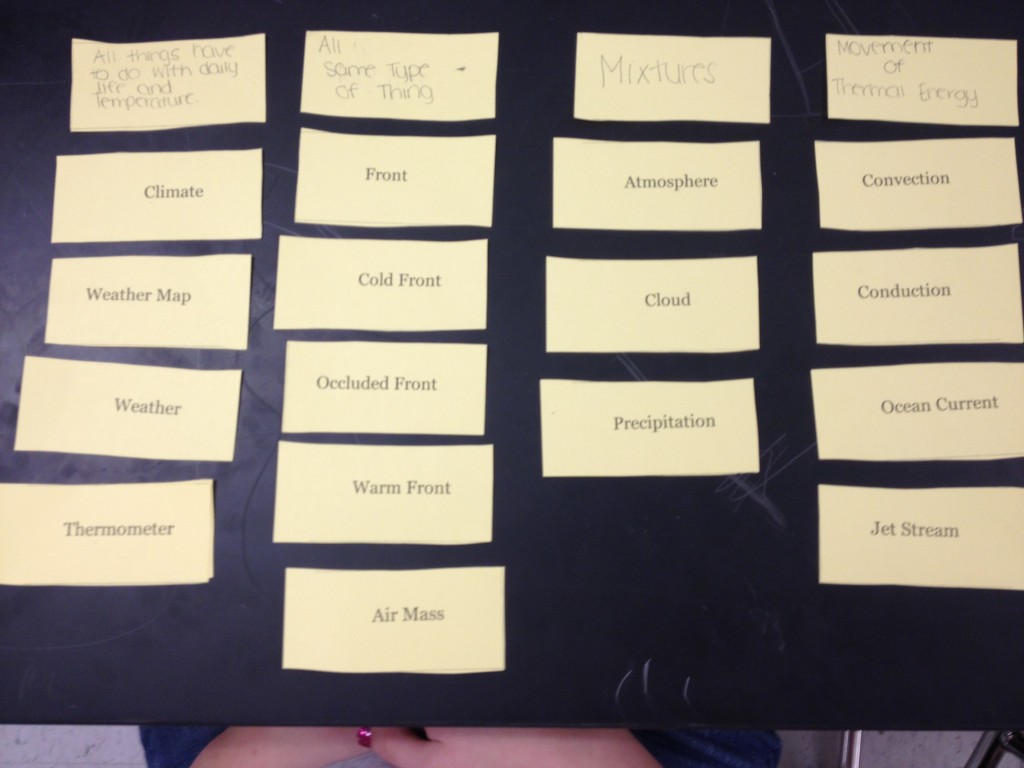
Yesterday, my science classes took 16 of our most frequently used vocabulary terms and classified them into groups. All the terms come from our weather unit. For these assignment there is no correct answer as long as the classification fits all items in the group. As I walked around the classroom, at first it appeared the student really knew what they were doing. I noticed many groupings that seemed to fit the assignment. As I started questioning the students about why and how the terms were grouped, I noticed a lack of deeper understanding. Many stated, “They just go together” or “I saw them on the same page as in the textbook.” I was glad they open the book to try to figure out the answer, but I gave this assignment because the answers aren’t in the book! As I kept questioning students, I noticed frustration creep into my classroom. My students really never thought about WHY terms could be grouped together.

We needed a quick lesson in grouping. I turned on the ELMO and placed a pen and pencil under the camera. I asked, “How can these 2 items be grouped?” Instantly hands shoot up in the classroom. “Writing utensils” was the first answer from the class. “What else could we add to this group?” I inquired. “Paper” was shouted out before I was done asking the question. “Does that fit class?” was followed by a chorus of “NO”. “So why not?” As the class worked through the explanation that paper is not used to write with but to write on, I saw a few light bulbs light up. Groups quickly went back to work on the classifications.  Below are a couple of results from class:

As class wound down, I noticed a few students were still struggling with classifying their terms. I started planning on the fly for the next day. In order for students to classify the terms they need to understand how the terms are connected. Does one concept cause the other? Are they similar? DO they require similar conditions? I decided that the students needed to write about the connections in their KidsBlog.org  accounts.

Here is the assignment:

I want you to write about how at least 4 words from our vocabulary that  work together to affect/cause/produce our large topic of weather. See the mentor text below for an example:

Mentor Text:

Connected words: Conduction- Convection-Jet Stream – Ocean Currents

The sun transfers energy to the Earth by radiation, conduction and convectionConduction occurs when the sun lights energy is directly transferred by contacting a surface on Earth. Convection occurs due to uneven heating of the surface, which creates movement from warm areas to cooler areas.  Due to these two methods of transferring the sun’s energy, water and air move. The jet stream is a high-altitude wind caused by the suns energy. Ocean currents are steady one directional flows of water also caused by the energy from the sun. Conduction and convection are methods for transferring energy to cause the jet stream and ocean currents.

As we entered the computer lab, I hoped for this assignment to help the students gain a better understanding of their vocabulary. While, I was presenting the task to the class, a couple of students raised their hands and shared how they felt the words are connected. For the second day, I explained that there were no right or wrong answers. All of the words  deal with weather so they are all interconnected in different ways. Students just needed to talk about how the terms go together. Below are a few examples of student work:


Warm fronts and cold fronts can cause warmer or colder temperatures you can use a thermometer to find the exact temperature. Occluded fronts  are also caused which are a form weather. Rain, snow, sleet and hail are all forms precipitation which fall from clouds. You can find the climate by averaging the weather.

The sun gives off energy through radiation throughout the universe. When the radiation nears the Earth, it must first reach the atmosphere. The amount of energy that gets through the atmosphere, winds, clouds (tiny of millions of water droplets or ice crystals), is the weather, (the conditions of the atmosphere in a given place and time). The weather tends to change similarly each year, and can always change whether we can predict it or not. This is the main  difference between weather and climate (the weather in some location averaged over a long period of time). The climate also deals with weather, such as temperatures, precipitation, etc… All of these rely on the sun for energy, the atmosphere to suppress (absorb) some of the energy such as harmful ultraviolet rays, for their ability to do their job and for us to simply be.


The sun transfers its energy to the earth by radiationconduction is when the suns energy s directly hitting a spot on the earth, convection is when the suns energy unevenly hits the earths surface causing that spot to move from cold to hot, do to this it creates wind and ocean currents. The jet stream is a wind in high altitude caused by the suns energy. Ocean currents are flows of water caused by the suns energy that move in one direction due to wind. All of these words are a way of transferring energy. in this case they all transfer energy that’s from the sun.


 As I walked around the room, these responses showed me that the students we finally connecting themselves to understanding their vocabulary. I feel that students benefit from spending time using terms they need to know. Teachers have to get past having student write a definition! Student need to see the terms in context and use them in a connected manner to clearly communicate their learning. I can not be more proud of my students and their learning today.

What is the goal of testing and data?

Data is a key component in education. Schools need to know where students are in their learning so instruction can be designed to meet students learning needs. Schools have always used data. We use data to help determine grades, know reading levels, math levels etc. Recently the government (State and Federal) has arbitrarily decided that the data schools have been collecting should be used to measure the effectiveness of teachers. The test design corporations, such as Pearson, create tests with little teacher input, to sell to states for the purpose of measuring students against a “standard”.  If students don’t achieve the standard, teachers can be deemed ineffective and eventually lead to the loss of their teaching position if low scores persist. Government has mandated this value add measure, with the desire to hold teachers accountable for their student’s learning. All the while placing little to no accountability on the student or parents for learning achievement.

So what is this data really? Is it a summary of everything a student has learned? Does it measure higher level thinking? Quite frequently the data is just a mere snapshot, of where a student is performing at a certain spot in time. Is it right to assume that a picture of a 75 degree sunny day is the norm for a Michigan Winter? No, but it happens. As well as a 30 degree snowy day in April. Like weather student performance can vary from day-to-day. Different events occur in their lives. Sleep and regularity of meals are major factors in student performance. Instead of looking at student day-to-day “Weather” data, schools should take a “climate” approach at looking at data. Look at performance over the long haul. Examine many different data point to see growth, over extended periods of time. Data should not only come from national standardize testing corporations but from locally created common tests as well. This does make it difficult to attribute the results to an individual teacher (current goal of testing) but shouldn’t the results belong to the individual student?

Students ultimately need to be held accountable for their own learning. There are many other ways to evaluate the quality of teaching. Learning is owned by the student. Schools goals are to make life-long learners who have critical thinking skills. These qualities develop at different rates in all learners. Just like all infants learn to walk and talk at different times in their life. To help hold the students more accountable, schools might want to change their structure. Instead of grouping students by age,  schools could group their by their skills and abilities or by their areas of interests or by learning styles.

The goal of testing and the resulting data, needs to remain student learning. Schools need to focus on holding students accountable for their own learning. Without being held accountable student frequently blame others for their results. I hear it often in my classroom, when discussion grades with students. “The teacher gave me a C!” We need to mold the conversation around students earning their scores. Right now, students see no relevance for most standardized tests. These test have little merit towards students’ grades or graduation. Colleges only focus on the FINAL standardized test of the student’s career, ACT or SAT for admittance.

If districts/states are going to mandate so many standardized test for our students, lets remember one thing: Make them focus on student achievement and their individual growth, not the effectiveness of teachers. Testing does not measure teachers, observations of practice and actions does. If teachers, performance is measured on tests we will end up with more cheating scandals like Atlanta!! More questions will arise about cheating in schools than we have had about cheating in baseball during the steroids area!

Learning Vocabulary with Metaphors

Today I used the following assignment in my science classroom:

The Learning target for today is to demonstrate understanding of vocabulary through the use of Metaphoric representation.

Part 1: Required- Vocab Metaphors

  • Pick 4 of our vocabulary words from our vocab list
  • Find a “non-scientific” picture that represents the word – Like we did yesterday in class
  • Explain why the picture represents the word

Click here to go to Quizlet to review vocabulary.

Go here to write your Vocabulary Metaphors in your  Kidblog.org.

Mentor Text for a 4

An ocean current is a continuous, directed movement of ocean water generated by the forces acting

When I read that definition I began to think about my advisory students who are preparing for the NWEA test.  To help them improve their math scores I am bringing them in the computer lab to review.  I feel like this test is like an ocean current because it is directing the path of education.   The direction of education is currently moving to align more and more with the tests.  Teachers and students are under great ”forces” to be successful.   Ocean currents are controlling the flow of water and tests are controlling education.

Mentor Text for a 3

Title: Vocab Metaphors

Vocabulary word: Front –  the atmospheric phenomenon created at the boundary between two different air masses

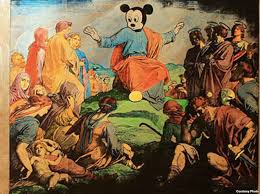
This image represents front because the Mickey Mouse character is a boundary between the two different masses of people.  Also the Mickey Mouse looks like he in the atmosphere. This connects to the vocabulary word because “Front” is a boundary between two masses of air.

________________________________________________________________________

The mentor texts are present to model for the students the quality of writing that is expected  in their blog posts. The use of Metaphors to connect to vocabulary was modeled in my classroom yesterday with the help of our wonderful, special education teacher, Mrs Hogan.

Many of my students are struggling to meet the criteria for success on this assignment. It is not that they can’t define the words, or use pictures to connect to the words, but because the students are concrete thinkers. My students struggle with the idea of a metaphor. When they want to be literal in the representation with a picture. Look at the following example for the word “Climate”

                  CLIMATE: the climate in the desert  stays the same all the time.

A picture of a desert climate to be a metaphor for climate? The picture does represent a climate but not metaphorically. I need to figure out how to engage the students at a higher level of thinking to create metaphors instead of literal representation.

As I continued to see literal representation after literal representation, I asked the class to reexamine the “mentor” texts. Ask themselves if they were following the model laid out before them. Many were upset. They acknowledge that the model was not being followed accurately. I stated that “It is okay to make a mistake, it is not okay to leave the mistake uncorrected after realizing it is a mistake.”  Student went back to work and created samples that looked more like this:

Ocean Current: The steady flow of surface ocean water in a prevailing direction.

This image of a highway is like an ocean current because the movement is continuous.

and

Atmosphere – is a mix of gases that surround the Earth. When I think of the atmosphere I think of salad, because salads are always mixed with something, weather it’s salad dressing, fruits and vegetables, etc.

Students need constant reminders of expectations. When expectations are not met teachers need to guide students back to the goal of the learning activity. Teachers need to point the students towards high quality examples of work. Allow the students to assess their own work and give them time to make the necessary changes. Students seem to rush into assignments with the desire of completion. Monitoring needs to occur to make sure learning targets are achieved.

Duck Dynasty Math, Science infused instruction!

It started this morning. Where will it end?

I awoke this morning with childcare duties on my mind. Amy, my wife was off at 8 AM to help coach our 8-year-old son Griffin and his Science Olympiad Team. My duties were to feed and entertain our 4-year old twins Gavin and Grace. Grace awoke as her mom and brother were heading out the door. After a quick breakfast she started playing independently. I headed up stairs to check on Gavin, finding him snoring away, I quickly checked my e-mail and twitter account.

On twitter I noticed the #satchat had started. I joined in a with a few comments and became engaged. As #satchat wound down, I saw a great discussion starting in #rechat. All about metaphors in education. I feel that metaphors are powerful and needed to help connect and engage students in their learning. John Spencer was leading a great conversation about the need to think carefully about metaphors used in education. Their power can be helpful and also harmful if used inappropriately. As I followed the conversation stream, Barbara Madden talked about the metaphors found in the reality show Duck Dynasty. She even shared a math problem created for her class connected to the television show.  We both shared out love for the show. Talked about writing a blog post about how we could connect student learning to the ideas presented in Duck Dynasty. I commented on how I would love to “read” a blog about these lessons.

At this point Math Minds had joined in the conversation on how great Duck Dynasty would be to connect students to their learning. Conversation moved to the creation of duck calls in the classroom. Seemed similar to the “straw” recorders built in my science classroom. To create the correct sound to call in a bird, frequency will have to be taken into account. Math and Science were coming together on Duck Dynasty. Needed to be merged together in our connected lessons. As Gavin walked into the kitchen to be served his breakfast, blog posts about lessons turned into an e-book. I was going to be an author? I, the teacher who tells his students that he is not a strong writer, is going to write a book.

Scares me a bit, but I am not doing this alone. This is going to be a great collaborative project. Three Twitter teachers are starting off with the goal of creating a math and science infused instructional book based upon a reality show. We are focusing on the areas where we have “expertise”.  If any other teachers feel so inspired by Duck Dynasty that they want to join us, welcome aboard. Contact us and share lessons you would like to see used in the classroom. Who knows where this project will lead. Who knows where this project will lead. Great Blog posts for sure, a book will ultimately be pieced together. After that who knows! Maybe even a meeting with the Duck Commander Crew!!

Stay tuned in a see where it goes. At least now I can buy Duck Dynasty DVDs and write them off on my taxes.