What should summer learning look like? 

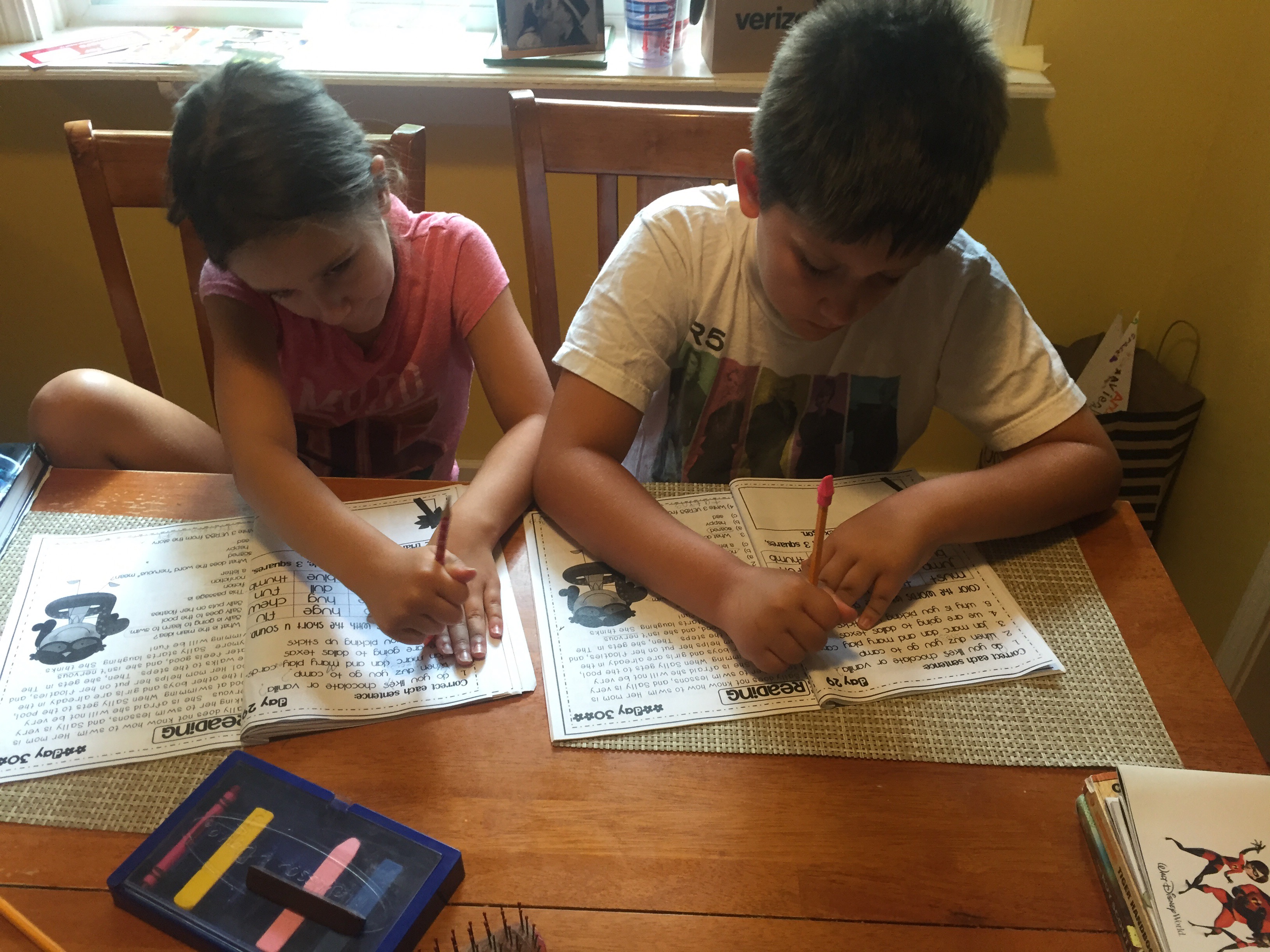
Digging into worksheet packet Photo by T. Bloch

Today I had to be the mean dad. When school let out in June, Gavin and Grace came home with packets to get them ready for second grade. Fifty pages of worksheets working on basic language arts and math skills. Now with the school year four weeks away we needed to get to work. It was torture for me to sit and watch my two seven year olds do school work on a beautiful Friday morning of their summer break. A question kept popping in my mind as I helped the twins struggle through 5 pages of worksheets. Should schools assign work for students to complete during summer?

The worksheets seemed the standard rote math practice, elementary grammar and some reading comprehension practice. Gavin and Grace completed first grade with good marks, achieving at grade level or above in all areas. Could they use practice to keep sharp? Of course we all can. Do these worksheets inspire students to learn? Absolutely NO. Grace kept asking if she “Had to” do them. “I get good grades, it is summer break.” Gavin chimed in ” Come on dad! I want to go in the pool this is no fun!”  I told them that they didn’t want to be the only students who didn’t complete their work. “Don’t you want to be ready for 2nd grade?” They nodded their heads, begrudgingly returning to their work.

Would I ever assign work like this to my students? NO, I try not to give my students any homework to value their home life. Was this different? 50 pages to complete during the 70+ day summer vacation . It was less than a page per day. Maybe we were just slackers and didn’t make a page part of our daily routine. We read everyday of summer, we do physical activity everyday of summer, should we do a worksheet everyday? What should summer learning look like?

Shouldn’t summer learning be more than a worksheet? (What can you learn from a worksheet anyway?)  Summer learning needs to be engaging. Students need to find the value of learning skills so that when school starts back up they will be motivated to learn. Summer learning should be the freedom to explore HOW adults use their education in their daily lives. The twins learned more attending their summer day camp than they ever will from the worksheet package.

Please comment on what you feel summer learning should look like.

Summer Games Photo by T. Bloch

Tying Knots- Snapshot of Learning

tying knots

“You know the bowline, please show the younger scouts” barked the scoutmaster to the patrol leaders. The younger scouts looked eager to learn holding ropes in hands. The patrol leaders had blank looks on their faces. Eyes looked up as if they were searching for directions written on the ceiling. Finally the senior patrol leader offered help. “Come on! We learned this for camping and life saving merit badges, you know it!” He then offered the common mnemonic device most people learn the bowline know: “The rabbit comes out of the hole around the tree and back into the hole.”  The rabbit’s motion describes how the rope moves to tie the knot.

For some patrol leaders light bulbs went on. Ropes started to move forming proper bowlines, modeling for the younger scouts. The other patrol leaders observed their peers, upon seeing the modeling remembered how to form the knots. One exclaimed: “I never use the bowline, totally forgot!” as he tied a perfect knot.

This small snapshot of learning that happen Wednesday night at Griffin’s scout meeting tells us three key things about learning:

  1. Learning needs to be used frequently to be recalled without prompts. The senior patrol leader had just finished his life saving merit badge that required him to tie the bowline multiple times. The other patrol leaders were more than six months removed the the last time tying the knot. When learning is distanced from assessment, results may not be accurate. Many of the patrol leaders knew how to tie the bowline but when initially assessed failed.
  2.  Prompts help recall. Once the senior patrol leader shared the rabbit mnemonic many  of the scouts who previously master the bowline, remembered how to tie the knot. Many times in our classrooms we expect students to perform without any prompts to help them recall learned skills. We all need reminder prompts, especially if we are removed from the learning. I was recently asked if I remember a person from college. Not recognizing the persons name at first, my friend show me a picture which helped my memory. Auditory or visual prompts will help students students remember skills learned. How can we incorporate them into learning and assessment processes?
  3. Modeling a process reaches most learners. The mnemonic story help some, but the modeling of tying the knot allowed all the scouts to be successful. How do we model before we assess learning? How connected is the modeling to the assessment?

When reflecting on this snapshot of learning it reinforces the negative feelings I get when administering standardized tests. Standardized tests are often distanced from learning lacking any prompts or modeling of skills. How can we create more accurate measurements of student learning?

At first glance one scout knew the bowline knot. After further examination ALL of the scouts knew the bowline. Our goal is for ALL students to be successful. Let’s make it happen!

#Makerspace Rage!

MakerSpaceLogo
From: http://www.clubcyberia.org

Over the past year, teachers can’t miss the hype around “Maker Spaces”. This movement is featured in trade magazines, presentations at conferences,  and thousands of social media posts. Making is a trait that makes us human. Schools today need to re-embrace making as part of their curriculum.

Sadly somewhere in the 1990’s or early 2000’s school lost sight of their making traditions in search of higher test scores and in budget crunches. By the late 1970’s making was a core part of our schools. Most districts engaged students in some form of industrial arts: from Auto Mechanics to Woods Shop to Home Economics students had making options at school. As the United States lost industrial jobs to overseas, products became cheaper to buy new than replace. By the late 1990’s a testing and college ready culture perforated our school systems along with budget cuts. Making classes were the first things to go.

Being a maker is a career skill! Most companies do one of three things (if not all 3): Make a product, market a product and service a product. If we teach our students to make products their will have mastered an valuable skill. By being makers our students gain skills most textbooks do not teach. Some making skills are:

  1. Identify a problem that needs to be addressed by a product
  2. Work as a team member
  3. Design a product to address the problem
  4. Budget and gather materials to build prototype
  5. Assemble and test prototype
  6. Communicate results
  7. Analyze prototype and redesign
  8. Mass produce product
  9. Meet Deadlines and stay in budgets

These making skills are needed in our workplaces today. Many employers look for this practical knowledge over college degrees when hiring today. Shouldn’t schools be developing practical work skills and experiences?

Our students need to be making things in every class, as often as possible. Most elementary schools encourage students as makers by doing crafts that connect to their curriculum. Art programs also seem to inspire students into making. By the time students make it to middle school most of these maker activities loose way to test preparation and core academic work. Making needs to occur in all subject areas on a regular basis.

Many teachers are discouraged about making due to the price tag that seems to come with it. Don’t be! Making can be done with cardboard collected at the local grocery store. Sure you can buy tons of cool making kits like “Little Bits” or “Tinker Create” but making has been done since the beginning of time with things found in nature. YES, we all want the cool bells, whistles and lights but making is an essential life skill that needs to be taught in schools. Make it happen on what ever budget.


As my friend Todd Beard says: “Hands on, minds on!”

Move making back into your curriculum! Our Kids Deserve it.


We’re talking about Bathrooms?

bathroom

Why are we wasting so much energy talking about bathrooms. In April, I wrote about the impact of the LGBTQ debate has on our students. The debate has raged on and is now spreading to more states. Today the federal government is stepping in to protect transgendered youth. I am sure this is just the start of a long public battle that will cause more damage than allowing students to go into bathrooms of the gender they identify.

Here in Michigan, bathrooms are taking center stage as Detroit Public Schools are in shambles and Flint has pipes full of lead. Fear and hate are energizing vocal activists. Some feel it is un-Christian to allow transgender students to go in the bathroom they identify with. Hmm… The Bible I read focused on love an acceptance.

What happens when a person who looks like a man has to go into the girls restroom, because he was born a girl? or vice versa? Bathrooms might need a bit of a redesign, putting doors on all stalls is long over due anyway. Really think about it, what do others see when you go to the bathroom? It is creepy to think anyone is looking, because only creeps look. People are mostly concerned about locker rooms. Hate to break it to them but students today don’t shower at school and most of them don’t change clothing either. Just ask coaches and gym teachers.

It is time to stop all the HATE and solve real problems in the world.

Inflexible Profession?

teaching

Schools are seeing teachers leave the profession in record numbers. When teachers are sick districts struggle to find guest teachers to cover all of the classes. Many states feel that they way to address the shortage of teachers in the classroom is to hire non-certified teachers. This will not solve the problem, it will only continue to devalue our trained educators and destroy our education system.

To address the shortages the issue needs to be examined by comparing teaching to other jobs that require similar educational backgrounds and skills. The once rigid corporate structures in the business world have transformed to  more relaxed corporate culture. Perspective teachers notice that schools have not kept pace with the transformations that have occurred in the business world around them.

Here are a few items that teachers notice which others might take for granted.

  • It is a 9-4 world: Most appointments for doctors, dentists, banks, or anything really occur during the regular school day. Teachers have to take time off work to make any of them. Other professionals flex their schedule to go to these important meetings. In most cases it requires 1/2 day off for teachers to attend.
  • GO at Lunch is not an option: Teachers usually have around 30 minutes for lunch. Not time to do much but for teachers it is packed with phone calls, helping students and trying to get a bite. Other professions just take an extended lunch.
  • Bathroom Breaks: Teachers have to schedule bathroom visits to fit their class schedule, many times going 3 hours holding it. Lunch and prep time are greatly valued just to get to the bathroom.
  • Meetings: Most employees expect meetings during their work day. In educations most staff and committee meeting are help before or after work. Teachers aren’t typically paid extra to attend. In other professions these meeting ONLY occur during the work day. Many of these professions also celebrate their successes during their work hours as well, going on corporate outings etc. Again in education this doesn’t happen.
  • Being accountable for time off: It takes teachers up to an hour to get ready for a day off. Creating lesson plans and getting supplies ready. Most jobs, a day off is a causal phone call and no more thought. Teachers usually come to work sick because the plan for the day requires them.
  • Changing on the fly: Most jobs have a regular pattern and plan. If something is changing plenty of notice is given. In schools the days plan can change in a moments notice. On the day you have a technology infuse lesson the internet goes down. In other jobs this is frustrating but employees often go home to wait for the system to get back online. Teachers still have their class to lead in a lesson.
  • Constant scrutiny:  Beside politicians, what other profession is under more scrutiny? Teachers here the constant bashing our profession takes in the media and by the water cooler. Who wants all this blame?
  • Attend children’s school functions: Teachers value education but so often they miss their own child’s milestones. Most celebrations overlap and occur at beginning and end of year when teachers are limited in ability to be absence for personal business. Other professions flex their work schedule to make it fit.

Educators are asked to be flexible to make learning happen for their students. Their work environment needs to catch up and be just as flexible. Can education become a more desired career if it can be more flexible?

To some these observations may seem petty or part of the JOB! But when the Profession is finding it hard to attract the brightest and best it might be time to look at how it compares to other fields.

Teachers teach because it is their calling! Many are being called but not picking up the phone! It is time to raise our profession!


Leadership Teachers Need

leadership

Education is at a crossroads. There are more teaching jobs than qualified teachers to fill them. The districts with the most teaching needs are become revolving doors for teachers as many are leaving the profession. This issues are due to the decade long attack on public education in America. Education reform advocates have have attacked teachers, unions and public school in general. Charter school have become an answer because corporations see them as an avenue toward profits. (Please note there are many great charter school, mostly run by non-profit entities) Teachers are looking to their leadership to help return public schools to their glory.  It is time for bold leadership to emerge, our TEACHERS, STUDENTS and PUBLIC SCHOOL need it to survive.

This leadership comes from the top. Many teachers are exhibiting signs of bold leadership but few district leaders are showing it. Maybe it is due to the politics of top level positions that the needed leaderships isn’t emerging in enough places. So what is needed in this leadership?

  •  Voice in educational reform: States have been allowed to get advice in educational reform from just about every sector but education. Educational leaders need to step up denounce reforms that are not based on educational research. Most of the reforms of the past 10 years make many teachers feel they are performing malpractice in their classrooms. Focus has been on test score and yearly growth not the STUDENTS. Politicians are so worried about media reports of state ranking to really examine WHY our numbers are where we expect them. So often district leaders will talk out of both sides of their mouths on these issues. Locally agree with teachers on the problems with testing but then  “We must follow the law”. What if the law is wrong? What if the law hurts our students? Educational leaders need to denounce reforms that hurt our schools. Speak up and tell representative that our teachers are the educational experts, listen to them.
  • Culture of Collaboration: Districts need to work together and collaborate. We can have districts cannibalizing each other. Advertisements for school of choice should not be posted in neighboring districts. In fact districts should collaborate on programing so they can offer true choices instead of same education in a different location. PD should be coordinated so the experts from each district can share with their neighbors. Competition needs to cease if school want to address their true purpose of providing a quality education for all. Funding mainly comes from the same source, lets collaborate to make the most of it. Many teacher evaluation systems have killed collaboration by pitting teacher against teacher to protect their jobs. How is this best for students?
  • Stability: Education is a constantly changing profession. Leadership needs to create stability for as many variables as possible. Make 10 year curriculum commitments, hire principals, district leaders and teachers with long term non-compete clauses we don’t see leaders jumping from district to district every summer. Life cycles of principals average out to 4 years in a building, that is not long enough for all the students to pass through! Should building level leadership be undergoing this constant change? Is it best for students and their learning? Many curriculum targets change every 3-5 years, again while most students are still sitting in the classrooms learning. Can schools keep up with the ever changing goals?
  • Be a relationship based leader: Know those that work under you. Know how their schedule. Know what drives them. Know why they work in education. Know the challenges they face daily in doing their job. Know your students. This knowledge will help you lead. It will help you raise your voice on their behalf. It will create a culture of respect in your district. While you are building relationships you will notice small things that need to be celebrated. Other issues will arise that need to be addressed. This awareness will impact the learning going on in your district.

The best way to lead is by example. These four traits are stress for classroom teachers.

Our schools need this bold leadership, be a positive deviant and add these traits to your leadership style and be the leader our teachers, students and schools NEED!