Reflective Teacher Challenge Day 10 – Countdown

Day 10- @TeachThough 30 day reflective teaching blog challenge 

Share five random facts about yourself.

Share four things from your bucket list.

Share three things that you hope for this year, as a “person” or an educator.

Share two things that have made you laugh or cry as an educator.

Share one thing you wish more people knew about you.

5- Random facts:

1. I went to a boarding school in Connecticut.

2. I went to school with Seth MacFarlane.

3. I own 3% of a microbrewery some friends from college started.

4. I am a survivor of an airplane accident

5. I was always told I would make a great teacher but took two trips to college and 10 years to figure out my passion.


4- Bucket List Items

1. Go to Rose Bowl

2. Sail across an ocean.

3. See an elephant in the wild.

4. Explore the Galapagos Islands.


3- Hopes for the year

1. Peace in the world- Don’t we all hope for this?

2. Reach my students, make those connections, see success.

3. A mild winter: Last year was brutal!

2- Things that make me CRY

1- How society views education and educators. Needs to be valued MORE than entertainment.

2. Poverty and its effects on my students. Richest country in the world needs to be more compassionate and caring for others.

1- THING

1. I CARE about education, my profession, my kids!

In a time of causual work attire: Dressing for success in school

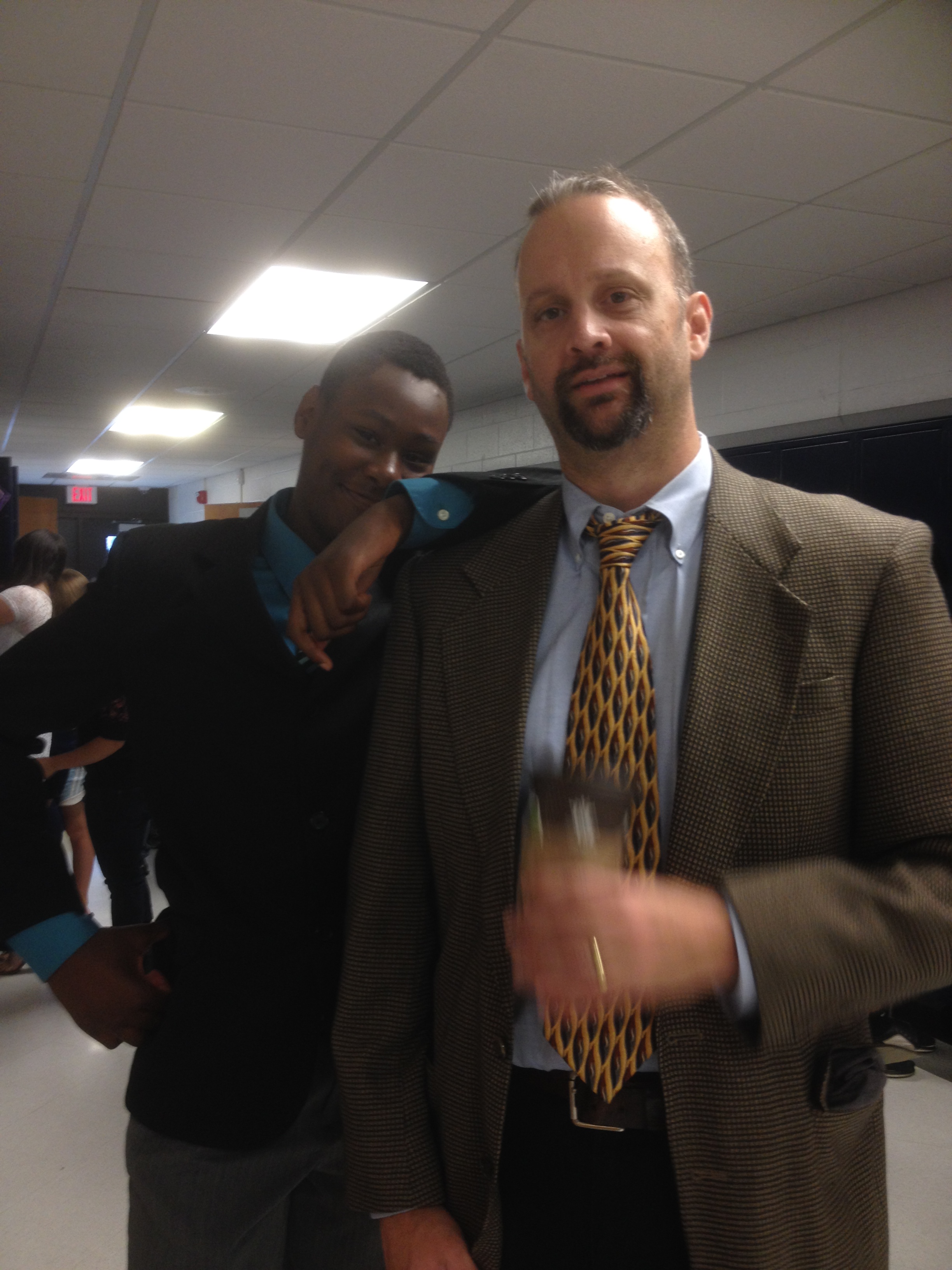
In a world of casual Fridays, golf shirts and dressing down it is nice to see people dress up for a day!This week our school is having spirit week to help celebrate the year of learning. We have your typical school pride day, favorite sports team day, Grade color day etc, but Today we took things to the formal level. Dress to Impress Day or as I called it Dress for success. Image

Students and staff Dressed up! T-shirts and Hoodies gave way to nice dresses, coats and ties were seen all over the school. It impressed me. Student behavior seemed better. Students stated they felt good about themselves because they were getting compliments. The overall feeling in the building was that of pride! Of course not every student can participate. A few commented that they had “nothing” dressy to wear.

IMG_3308[1]

It was nice to see students take pride in their attire. Girls learned that heels are painful for their feet to wear all day. I took the time to help boys learn how to tie their ties.  It felt great for me to get compliments for being dressed up, finally being called “professor” by a group of students. (My normal attire has me looking more like a golfer than a teacher.)  Staff spent time modeling how to dress for success. I feel it was a very valuable experience for our students. Very different than the typical school spirit day.

IMG_3305[1]

A big thank you to our wonderful building staff for modeling how to dress for success! The student council and their leaders should get kudos for planning a day of modeling self-pride.

Next time your school is planning spirit week, place a positive day like “Dress for Success” next to wacky Wednesday and Sports Team Friday. You will be glad that you do!!

The needed struggle with change in education

Education is changing at a rapid pace. Over the last two years, my school district has made more changes than the previous 12 that I worked there. Schools are dealing with so many changes teachers heads are spinning.

  • Curriculum changes,
  • Legislative changes
  • Testing changes
  • Evaluation changes
  • Instructional methods changes
  • Technology Changes
  • and of course students changes

Many arguments say it is about time the outdated American educational system made some changes. Educators are trained to ask question, to seek information and find out the reasons changes are made. Highly Effective educators seek research data that supports a change in their instructional practice. ALL schools require data to support changes to be presented as part of school improvement plans.

Currently teachers feel enormous changes come from outside of the school district, based upon legislative agendas. The majority of this “legislative” change has little research and data supporting it. Teachers and Schools lobby to get more data and research but few are listening. Teachers feel threatened by these changes that they had little voice in making. Feeling defeated teachers start to put up walls, not wanting to listen to any ideas about change.

Education at the same time, is attempting to evolve into a better machine for the 21st century and beyond. Blended learning models, flipped classrooms, standards based grading and many other student centered changes are happening. Sadly,some teachers overwhelmed with change, resist the changes that they can. Teachers need to look at these changes carefully. DO they make learning improve in my classroom? Will they help my students become engaged and take ownership of their learning? IS it something my students need? (Are my students performing WELL now?) Are the results there or is it change for change sake?

Educators need to look at change in 3 ways:

1. Change you can’t control- Legislative change we can not do anything about once laws are passed. Sadly many legislators don’t listen to our voice on these issues. We can dwell on this change, just deal and move on. (Knowing we voiced our opinion when we could)

2. Changes where our students benefit-Research shows that my students will benefit. This is a change I have to make and invest time to make it happen in my classroom. This might mean I have to replace a current technique or instructional plan. This change might be hard work, but most things worth doing are hard work.

3. Change for change sake- IF a change shows no value to our students, it should not be made! Teachers have to be careful with all the educational jargon and “sales” pitches on new “programs”. It is always best to talk to teachers who are using the tool to hear first hand how it works and if it improves students’ learning. Remember that what works in one place, doesn’t always work in another. Look for data that shows repeated successes.


Change is an essential element in education. Without change, students would still be writing on chalkboards, watching film strips, and in one room school houses. Struggling with change, is natural. Educators must question changes to make sure it is what is best for their students.

We must remember not to fight the NEEDED change because we can, since we can’t fight the BAD legislative laws that change how schools operate. We have to remember to separate the political fights from our students’ classroom needs.

 Below is a link to an #mschat on Educational Change.


Is hitting a ball harder than educating a student?

This time of year has me thinking about baseball! The weather is slowly warming, plans begin to grow, and opening day is upon us in the Major Leagues. I have many fond memories of baseball growing up, playing with friends in open fields. Never fielding a full team but just the pleasure of pitching, hitting and throwing. Growing up my father put more emphasis on individual sports, “You want to play a sport that you can do by yourself” he would often share. Reminding us that we never had 18 kids to play a “proper” game in the neighbors yard. As I grew up, I did focus on other sports enjoying basketball, tennis and golf because playing them did not require a full squad of players. My father also place a greater value on knowledge than physical sports skills. Should I have spent more time learning to swing a bat?

This week Miguel Cabrera signed a record deal to play baseball, $292 million dollars for the next ten years. I am happy for him. He is probably the best baseball player of our time and in the discussion as being one of the best of all time. Miguel Cabrera is going to make roughly $50,000 per at bat for the next ten years with the Tigers. (If he averages 600 at bats per year.) That is about the average yearly salary for teachers in Michigan! WOW!! Over the course of this 10 year contract he will make enough to pay for 6000 teachers for a year. Well he is the best player in baseball right now, right!

Cabrera has a .321 career batting average, which is great for baseball (50th all time). This means he makes an out .679 of the time he makes an out! If a teacher in the classroom had .321 success average and .679 failure average, most school districts would find them ineffective. Yet in baseball this is one of the best ALL time? Is hitting a ball harder than educating a student? Education and teaching is undervalued in today’s society. Fans flock to “average” teams. Every school child aspires to be a professional  athlete at some point growing up. How can we make this happen for education and teaching?

If the current trends in education continue, our best students will not want to be educators.

What do we do with these results?

So the data is in from the Michigan Educational Assessment Program(MEAP) Fall 2014 8th grade  science test.  Doesn’t look good, 20 % of students in the state were proficient 55% Not proficient at all. Staggering numbers to say the least. To really understand the MEAP science results one needs to understand the testing cycle. The 8th grade test is given in October covering standards taught from 5th grade through 7th grade. Due to limitations on the number of questions on the test (around 40) MEAP test questions narrowly focus on just a few units of study covered over a 3 year span and cover  general science processing skills. The science test is given as the last assessment for the students to take in the state assessment program so they are a little tired of testing. These test are used to grade the schools and districts but have little to no meaning to the students. Grades are not effected, proficiency is not required. As a science teacher I am ashamed of these scores. What do I do?

Are the results an accurate measure of Michigan’s students science ability? We still have students going to college to be doctors and engineers. Maybe they are the 20% proficient in 8th grade. Should this large a group score so poorly on any test? I don’t think so. When I have gotten similar results in my classroom, it is time to re-examine the curriculum used, how it was delivered and if it lines up with the test. Obviously something is amiss here. When looking at the science MEAP trend:

It is even more troubling. Out of all the students in the state of Michigan less than 20% have been proficient for 5 strait years. This is totally discouraging as a science teacher. 5 years with only minor improvement. One would think the test would be changed to give the educators and districts better feedback as to how their programs were working. With these results it just looks like schools are not teaching much in the way of science. Is that the case? DO districts focus so much on math, reading and writing because they are tested every year and let science slip to the wayside?

The state of Michigan needs to examine this test, adjust it to measure the skills taught. Make sure that the questions are above the knowledge level with out being vocabulary specific. Or better yet stop wasting money on a test that doesn’t give us results that can be used to help our students learn.

It reminds me of a story my younger brother shared when in college. Philip was a graduate student at Duke, taking an undergrad prerequisite at UNC. His professor had to talk to with him because he ruined the curve. He received scored a 96% on a test that the class average was 35%. The professor wanted to curve the test but Philip’s score would not allow him to curve it equally for all students so the professor had to explain his actions. As my brother shared the story he state, “It is ridiculous to create a test that the majority of your students fail.”  My sentiments for the Science MEAP!

MEAP Data screen-shots from www.mischooldata.org

Where is the motivation in our schools structure?

Before children enter school, motivation comes naturally. Infants want to learn to walk, to get where they want to go. They learn to talk to communicate their needs. Motivation seems like a natural instinct. As 5 year-olds enter our schools they are self-motivated to learn, and explore. Discover in itself seems to engage and keeps students moving down the learning trail. Then out of nowhere students seem to loose the spark. Not all of them, but enough to make a noticeable difference. Teachers have to put on a “show” to engage learners, often struggling to hold their complete attention. It seems these students start loosing the fire for “School” learning around 4th grade and it stays un-sparked till high school. Why is this? Could it be school structure?

There are many reasons students, loose the desire for prescribed learning during these “middle” years of school. I am going to focus on ONE key reason that educators should examine for change. SCHOOL STRUCTURE: Here are a few questions to ponder:

1. Is it appropriate to place 9-14 year olds to sit in desks, quietly for an 8 hour day, expected to learn, surrounded by 30 of their peers? Do adults learn well in this environment?

No, not appropriate. Students need to have freedom to move around, get comfortable, socialize and have private spaces. Schools should look more like coffee shops or book stores, filled with comfortable seating and meeting places. Teachers should move freely among the students asking questions, checking in, giving feedback, while allowing students to learn at their on pace. Look at the office environments of Google and Mircosoft of inspiration here.

2. Would you work hard to learn, knowing you will move on to the next topic/level after a period of time?

After a couple of years in school, student realize that the they move on to the next level with or without effort. Grades might suffer but they are just LETTERS. Do any of us really like to work hard? (Well we do when we find passion) Students are still exploring for their passions, hard work always meets resistance at first. Schools need to foster passions, not force work towards the unknown. Students are turning off on subjects because they are hard before passion has a chance to set in. A current student told me he was bad at science. His passion was working as an audio technician at a teen night club. It took awhile but now he is excited to learn about sound and waves in science class. Schools structures make it too easy for student to sit back and arrive at the next level instead of earning it.

3. Should kids be told what is important to learn? or discover what is important to their lives?

The curriculum in schools is to defined. Requiring specific units of study, without giving students time to explore a topic based on their own interests. In my science curriculum we spend so much time studying the plant kingdom, heredity and genetics during our biology unit. Students always ask great questions about Animals. While I do answer their questions we don’t have time to explore the animal kingdom as much as students desire. Teachers are told to teach to students learning styles, isn’t their learning desires apart of their style? Curriculum needs to be more open ended. What students learn in school isn’t really important it is HOW they learn that is. Once a student learns how to learn anything will be accomplished.