If it can be Googled ….

google

“But the teacher said most of the kids who fail the test don’t know the formulas!” Griffin exclaimed as he focused on writing a series of 4 geometry formulas down. I wanted to focus on how to solve the problems, but Griffin was concerned with memorizing the formulas. Is this where Griffin’s valuable learning time should be spent?  Do engineers have all their formulas memorized? or can they Google it?

When I first started teaching I though it was important for students to learn (memorize) everything. Now I think differently. As an adult I don’t always have formulas on recall mode in my mind. I like to look them up to refresh my memory. For my students I list all the formulas we have been working on at the top of tests, along with a word bank for reference. I feel if it can be Googled, I shouldn’t assess it. I want my students understanding how to apply their knowledge, not regurgitate facts. In today’s world everyone is walking around with Google in their pocket.

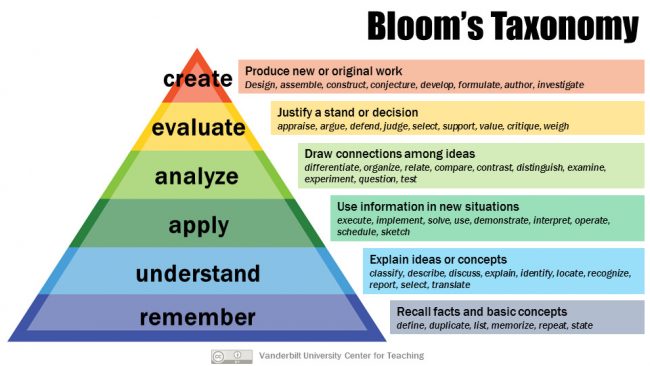
Schools need to rethink how we assess in the secondary level. Students can do so much more than just site facts. Asking what the chemical symbol for gold (AU) is not going to measure anyone’s intelligence or tell if they are meeting a science standard. A better question would be: What family of elements is gold (AU) most likely to bond with? With a periodic table a student could show their understanding of elements. Assessments must move away from recall level questions up bloom’s taxonomy towards creation.
Blooms-Taxonomy-650x366

Sadly most standardized test are stuck in recall mode. Our society is stuck in a pre-google notion that recall equals intelligence. Recall is just a muscle that if given enough exercise it can be impressive. Many of our students can recite sports teams rosters, quote movies or sing the words to popular songs, does this make them intelligent? No it makes them have information they value. Our students need to learn how to apply ANY knowledge. If I were creating a standardized test, I would want everyone to start on a level playing field. Giving test takers all information needed to solve the problem. Then give space and time for a solution to be found. Instead most test measure recall skills from what might have already been taught.

If a assessment question can be Googled to find an answer, it is not a good question!


Leading a student to knowledge…

horsetowater

“Why do I need to know this Mr. Bloch?” a student cries out from the side of the room. I answer the question carefully to the middle school science class. “We need to know how sunlight is converted into food that we use for energy.” “Why?” he exclaims again, “I know food gives me energy and can Google photosynthesis so why?” Conversations like this happen regularly in today’s classrooms. Teachers present knowledge and parts of their class don’t care to learn. Roughly 1/3 of my students display apathy to learning new things. When was the last time you needed to know the in’s and out’s of photosynthesis?

Growing up I didn’t question what I was learning, I just knew it was required to move forward so I learned. So did most of my classmates. When I was trained as a teacher, I learned what to teach, how to teach the material in engaging ways, how to manage disruptive behaviors, how to adapt lessons to students with learning disabilities and how to assess learning. I never learned how to make students thirsty for learning. Is that a teachers job? Yes, but without the help of a society that places value on education it can be very difficult. Society judges schools on their test scores, these scores require the students to want to learn what is needed. (What these tests actually measure needs to be addressed in another blog post. )

great teaching

Teachers need to focus their instruction on the art of motivation! We need to engage students in their desire to learn new ideas. Reading “Teach Like a Pirate” by Dave Burgess opened my eyes to this just over 4 years ago. Now their are a slew of incredible teacher written books that address the idea of creating thirst in our students. Our students see the power in knowledge but they can Google all facts. Students need to see that applying knowledge to new situations is what separates individuals and grants power.  When looking at the top 10 skills needed for workforce in 2020: communication and collaboration are the most critical skills are students need for their future. For the past 4 summers I have spent countless hours rethinking HOW I teach to make my students PARCHED.

Remain ever thirsty for knowledge my friends.

The Dying Art of Reading

The-Art-of-Reading
From Aljumuah.com

“What are you playing on your phone?” a familiar voice rang in my ear as I sat in the back of a Boy Scout Meeting. I looked up to see Gabe, a 15 year old, who was bored with the scouting activity. “I am reading an article, see?” As I turned my phone towards him so he could see my screen, his face soured, “That’s no fun, why bother reading unless it is for school?”  I probed further to understand, “You don’t read for pleasure?” “For pleasure? Video Games, Movies, Youtube that is pleasure, reading is torture!” He scoffed. I have heard his sentiments echoed in my classroom many times. Is this the opinion of most of our youth?

I remember books being my escape as a child. They allowed me to travel the world and see amazing things. Books were so much more than words on a page, they were movies that played in my mind. Vivid with colors, details and emotions. Nothing was better than sitting outside under a tree or crawling under the covers with a great book. I recall the first time I saw a film that was based on a book I read: “Where the Red Fern Grows” by Wilson Rawls. I was in fourth grade. I remember being excited since I knew the story. Then being a bit disappointed because the Hollywood version of the book didn’t match up with the film that played in my mind when I read the story. Too this day I struggle with watching films based upon books because the book is ALWAYS better. Good books draw you in, Great books hold you there so that you never want to put them down. Why doesn’t Gabe see this?

It seems that books have been replaced with other forms of media. It takes less time and effort to watch the film. Does the next generation understand they are allowing others to tell the stories from their perspective or interpretation. Should we show students all the versions of Romeo and Juliet or Robin Hood (or heck Spiderman) and then have them read the original book (Play or comic)  to figure out which film connects to their vision? I see the death of reading in my own children. My boys don’t dive into books like their sister. While Grace curls up on her bed reading daily, the boys resist this urge. They are more visually stimulated by film/TV.

Is it access and quantity of film versions that drives the move away from books? Or is it the speed of delivery? Or is it schools that have required reading lists? What ever it is, adults need to model WHY we read. It isn’t just for school and to gain information. Most of us started reading for FUN! The best movies around are made by us as we read a well written book.

What are our students doing?

videogaming
From: Internet Addiction Blog 

“Why didn’t you let me know you were at my house last night?” Griffin’s friend asked as we walked into the scout meeting. Griffin had stopped by the night before to get signed off on requirements for his first aid merit badge by his dad. “Where were you?” Griffin inquired. “Downstairs, asleep! My summer awake hours are 8 pm to 6 am.” As a parent listening to this conversation I was stunned that parents allowed their children to live this way. I asked a few questions. He explained that during the summer he plays Call of Duty with friend online at night. If he is up during “normal” hours he gets bored. Lucky for me Griffin thinks staying up all night to video game online is crazy.

As I reflected on this conversation, I got to wondering what my students are doing this summer. Before school got out, I surveyed my classes about what they were looking forward to during summer. Many responded with “TV, Video games or Movies.” Aren’t these things that students can do year round? Some did share about camping, sporting or trips to see family. A few responded with “Nothing”.  I guess I am lucky, I can spend most of summer at home with my kids. They read, write, and explore many things. This week they spent 3 days at Stony Creek Metropark attending a nature camp.

IMG_1702
Photo Credit: T Bloch

Our students need sumer activities to stimulate their minds, challenge their thinking and keep them busy. Yes, children need to have voice and choice in what they do. They need free time to explore on their own, but they also need structured time. Time to explore new things. Time to be challenged. If children only choose what they want to do, how broad will their experiences be? Some children love trying new things but others resist. Children need to be pushed into trying a variety of activities out. Often they find something new they enjoy! My son Gavin didn’t want to goto nature camp, he told me he would rather spend quality time with “Netflix” but he learned he likes making! After building a catapult he said: “Dad can I make a Robot?”

IMG_1709.JPG
Photo Credit: T Bloch

Society needs to make sure their are plenty of opportunities for students in the summer. Students should not be allow to just sit at home with screens as sitters. Many communities have camps at their churches or schools that offer this opportunity. Hopefully my students are taking full advantage of their summer! I will be tagging all my children’s summer learning with #summerlearningfun on Twitter and Instagram. Join me in shedding light on how our youth should use their open summer time to learn independently.

Blinking Red Light – Why Teachers Have Unions!

message

The light is blink on the phone as you enter your classroom at 7 AM to start the day. Who called? What did I miss in my e-mail/newsletter/web-page update/remind announcement? A familiar voice comes on the speaker, it is your principal, “I need to see you when you get in!” What is so urgent? What did I do?  Worry enters the mind, all kinds of emotions take over as tears start to form at the corner of your eyes. Why am I being called to the principals office?

This scenario doesn’t happen very often, when it does teachers are thankful for being union members. The message creates panic; students goto the office not teachers. Usually if a Principal needs to talk to a teacher they stop by their room to converse casually in the hallway. What causes an unscheduled teacher office visit? It can be a number of things: Phone call from parents, concern shared by co-worker or student, observation by principal. Teachers fear the worst. They need someone to sit by their side. Help them gather their emotions and discuss the situation. Good administrators will give the union representative a heads up. The teacher is offered the opportunity to have the representative in the meeting. No harm in having an extra pair of ears attend to listen and give them an unbiased view of the situation.

Most teacher office visits are simply to clear up misunderstandings. “I saw you leave school before the designated time!” the administrator might assert. “I had to make it to my son’s sporting event, it was a one time occurrence” the teacher humbly answers. “Next time let me know ahead of time, hope you made it” would be a reasonable administrator response. Other meetings can be more serious dealing with allegations from students or parents. The union representative is present to be an extra set of ears and make sure the teacher’s contractual rights are followed. Representatives help calm nerves to enable clear communications about the situation. Imagine hearing serious allegations from an administrator all alone!

Teachers learn how to teach. They learn how students learn. Learn the in’s and out’s of curriculum, best practices and how to integrate technology. No where in their educational process do they learn how to read a contract and deal with allegations (which can often unwarranted). Teachers go into teaching to help students and feel that everything they do is what is best for their students. Misunderstandings and mistakes happen. This is when an expert in the contract and teacher rights is needed. The teacher’s union provides this expertise.

There are so many reasons to be a member of your teacher’s union. Five main reasons listed here. In a time of need teachers need someone to help guide them to their best decision. Union representatives provide this support. No teacher ever plans on getting called to the office but it can happen when they least expect it.

In it for the Outcome!

outcome

This weekend as I was watching ESPN’s 30 for 30 Celtics/ Lakers Best of Enemies a line about the late 70’s Celtic players attitude from narrator Donnie Walhberg resonated with me. “The paychecks come if we win our lose, so just cash your check.” It was referencing the lack of passion from players who just seemed to be going through the motions.  It is seen in every profession, when passion gives way for a need of income to just live. This attitude often come from a lack of voice and choice in career or when employees feel their outcomes are beyond their control. Outcome focus is lost and income focus only remains.

Anytime educators raise their voice about income, the common comeback quickly shifts to outcomes. “Teachers are in it for outcomes not incomes.” Yes, every teacher knows that they will not get rich teaching, but they expect to support their families and live a decent life. Why is this saying only about teachers? Shouldn’t it be about ALL careers? From doctors, lawyers, dentists, engineers, and politicians to janitors, bus drivers and service careers? Society is contempt paying ever increasing prices for everything but their public services like education. Individuals in most careers are seen as successful by their income. Corporations can turn what ever profit they see fit. Our politicians feel that tax cuts will enhance the business world because they will have more money to create jobs. BUT in education more money is seen as a waste? Society needs to focus on outcomes! If we desire well educated students, we would spend more on schools than sporting events, concerts, movie tickets and prisons.

Right now schools don’t seem to be performing well. Should we blame teachers? or Society? Parents treat their school systems like day care, anxious for the first day of kindergarten so they no longer have to “pay” for someone to watch their children. Constantly pulling students out of school for vacations and to be their day care providers when one can be found. Most doctors and dentists offices only have hours during the school day because their services are more important than school. Our music and mass media often works against most school’s teaching. Modeling poor behaviors, bad grammar and lack of respect for others. Why do some students hate school? Because their world is entirely different than anything they see in schools.

We need to all work together to focus on OUTCOMES! Collaboration will lead to a increase academic gains. It is time educational values are reflected in out society! Start by listening to educators and valuing their opinions. Teachers are role models! Their average income is less than $50,000. So feel athletes or other professions are role models here is a look at their salaries:  On average, NBA players make $5.15 million, MLB players make $3.2 million, NHL players make $2.4 million, and NFL players make $1.9 million per year, according to Forbes doctor’s average $189,000. dentists $146,000, lawyers $136,000. Pay reflects what we value in our society. Are we all focused on outcomes? Sports teams have millions spent on players who don’t even play. The United States is not ranked even ranked in the top 10 for health care!

It is time for our society to show it values education! Spend money here and we will all be supporting positive outcomes!