Tying Knots- Snapshot of Learning

tying knots

“You know the bowline, please show the younger scouts” barked the scoutmaster to the patrol leaders. The younger scouts looked eager to learn holding ropes in hands. The patrol leaders had blank looks on their faces. Eyes looked up as if they were searching for directions written on the ceiling. Finally the senior patrol leader offered help. “Come on! We learned this for camping and life saving merit badges, you know it!” He then offered the common mnemonic device most people learn the bowline know: “The rabbit comes out of the hole around the tree and back into the hole.”  The rabbit’s motion describes how the rope moves to tie the knot.

For some patrol leaders light bulbs went on. Ropes started to move forming proper bowlines, modeling for the younger scouts. The other patrol leaders observed their peers, upon seeing the modeling remembered how to form the knots. One exclaimed: “I never use the bowline, totally forgot!” as he tied a perfect knot.

This small snapshot of learning that happen Wednesday night at Griffin’s scout meeting tells us three key things about learning:

  1. Learning needs to be used frequently to be recalled without prompts. The senior patrol leader had just finished his life saving merit badge that required him to tie the bowline multiple times. The other patrol leaders were more than six months removed the the last time tying the knot. When learning is distanced from assessment, results may not be accurate. Many of the patrol leaders knew how to tie the bowline but when initially assessed failed.
  2.  Prompts help recall. Once the senior patrol leader shared the rabbit mnemonic many  of the scouts who previously master the bowline, remembered how to tie the knot. Many times in our classrooms we expect students to perform without any prompts to help them recall learned skills. We all need reminder prompts, especially if we are removed from the learning. I was recently asked if I remember a person from college. Not recognizing the persons name at first, my friend show me a picture which helped my memory. Auditory or visual prompts will help students students remember skills learned. How can we incorporate them into learning and assessment processes?
  3. Modeling a process reaches most learners. The mnemonic story help some, but the modeling of tying the knot allowed all the scouts to be successful. How do we model before we assess learning? How connected is the modeling to the assessment?

When reflecting on this snapshot of learning it reinforces the negative feelings I get when administering standardized tests. Standardized tests are often distanced from learning lacking any prompts or modeling of skills. How can we create more accurate measurements of student learning?

At first glance one scout knew the bowline knot. After further examination ALL of the scouts knew the bowline. Our goal is for ALL students to be successful. Let’s make it happen!

Overcoming my prejudice 

By: T. Bloch 2016

I have always had a negative imagine of bikers and the motorcycle culture. Growing up the son of a doctor, I was alway told to stay away from motorcycles. My father shared stories from the emergency room about how dangerous cycles can be. Never having first hand connections to bikers, I assumed the movie depictions of bikers as hooligans and degenerates were accurate.

Last week Griffin’s scout troop was asked to help out with a veterans ride sponsored by Wolverine Harley-Davidson in Clinton Township Michigan. At first I was uneasy. Not many scouts were signing up to help out. Griffin, being eager to check out something new, insisted that we attend. I couldn’t say no to my son. With reservations we signed up to attend. Visiting veterans at the VA Medical Center in Detroit is a good thing to do, even if the event is being put on by a bunch of bikers.

We arrived at the Harley dealership early. Griffin was a bit nervous seeing rough bikers all decked out in leather. Smoke pluming from their mouths as they exhaled. I hid my prejudice and  walked up to meet the organizers. We were greeted with wide smiles and open arms. A couple of female bikers were eager to get pictures with Griffin all decked out in uniform. They asked how were heard about the event and were excited to have us join the ride, even from our car.

I was astonished by the organization and rules the cycle club had in place for the ride. We followed the Harley line of 84 bikes the 20 miles downtown to the VA Hospital. Nurses meet our group at the door. The event organizers restated the purpose of the ride: “To put a smile on our VETS’ faces and get them outside for some air”. He announced that the ride raised $10,000 for the veterans recreation services department, “because they need to get outside now and again!” Then each participant went to a hospital ward to deliver a bag of toilettes to every veteran in the hospital. “If they can get in a wheelchair, bring them out to check out our bikes!” Were the last words shouted out before we entered the hospital.

Griffin meet Mr. Z and World War 2 veteran. He was excited to just see a young man’s face. We took Mr. Z outside. He marveled at the wondrous machines parked at the front of the hospital. Griffin listen as Mr. Z shared advice and stories of his experience. All the bikers were interacting with Mr Z ad thanking him for his service. Mr. Z was sad when we had to leave 2 hours latter. He just enjoyed talking to those that would listen.

My perceptions were changed this day. No longer will I prejudge a group based on stereotypes. Thanks to Griffin’s desire to go, I learned that this group of bikers are passionate about helping and serving others. I am sure many road clubs do similar things. My lack of experience led me down a road of prejudice. As learners we need to take on new experience with open minds. We can’t let our fears of the unknown hinder our lives.

As summer’s end creeps upon us, I will need to remember to overcome my prejudices during the up coming school year. Judging students by their daily actions and not lumping them into a stereotype.

Griffin and Mr Z by Tbloch 2016
by Tbloch2016

Oops! My bad

oops

I published a blog post with grammatical errors. I have to admit it wasn’t the first time or will it be the last time. I make mistakes. Writing has been a life long struggle for me. I seem to do a much better job with my words when I speak than when I actually slow down to capture them on my blog. My mind seems to flow faster than my fingers can type the words down. I often make mistakes. Frequently my mistakes come in the form of word replacement: such as typing “so” when I mean “some”.

My wife frequently asks if I proof read my work?  Of course I do re-read my work. My brain still contains the original wording. Often during a quick re-read my mind skips over the errors inserting correct word, missing the error. My proof reading improves if I set the writing aside for a day or two and re-visit it with a mind free from the original writing process. I should take a pause in the writing process and give my work more time. Errors still occur but I usually catch the glaring issues.

I blog to take ideas and put them to paper. I don’t blog to be perfect. The great thing about modern technology, when I find mistakes I can correct them even after publishing a post. Recently some readers have commented on my errors. I appreciate their corrections, I strive to do my best. What disturbs me is that some value perfect writing over quality ideas. When I read ideas take center stage. I frequently notice minor error in what I read. I don’t let it distract me from the overall purpose of the writing. Ideas drive the world not perfect writing. Writing errors surround us in all formats of writing. Authors don’t intend to make the errors they just happen. In my writing I attempt to be timely and respond to events in the world around us. This means I don’t often take the time needed to make it error free.

In my classroom I want to be a model for my students. Someone who has flaws but constantly tries his best to work through them. In the past I have focused too much on students’ grammar and not enough of the ideas presented in their writing. The “red” ink seems to discourage students from writing or even sharing ideas. Teachers need to encourage more writing, errors and all. When we read our primary focus should be on the ideas presented. Grammar is important, especially in published works, but should be secondary focus behind ideas.

I was personally discouraged from writing for many developing years due to my grammatical errors. Every paper was returned with so much red ink, I barely noticed the comments about the quality of my ideas. As educators we need to encourage writers sharing feedback that focused on the strengths of ones writing with side notes on the weaknesses.

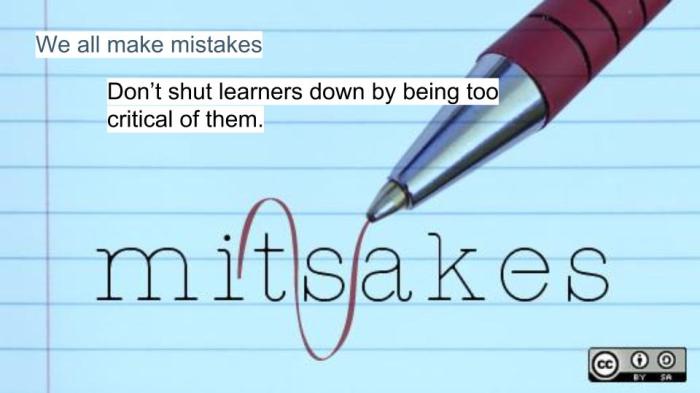
We all make mistakes

We all make mistakes, don’t shut learners down by being too critical of them. Thank you for excepting me errors and all!

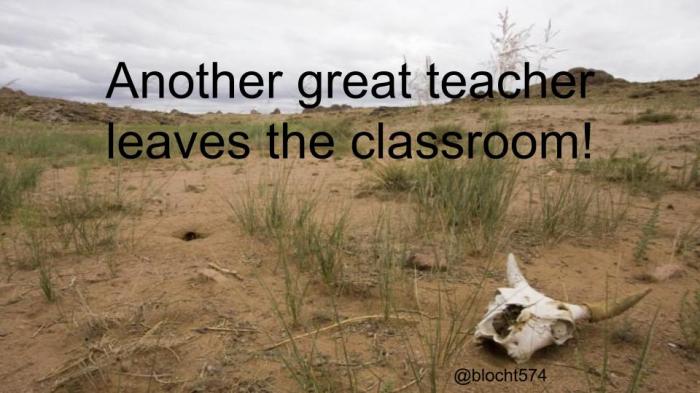
Sadly, Another one bites the dust!

Another one bites the dust  (1)

At 13 years old all she wanted to be was a teacher! She sat in the front of my classroom, paid attention and excelled at all she did. As she advanced through high school she would return to teachers’ classrooms to assist and learn the craft. In college she remained in constant contact with her former teachers for advice and wisdom. After graduating with honors, she worked as a guest teacher in hopes of fulfilling her life long dream of being a classroom teacher. All her hard work paid off, two years ago she secured a teaching job in a district neighboring the one she attended. Her teachers could not have been more proud, she has the skills, passion and patience to be one of the best teachers. We all saw it in her when she was 13.

Last week she quit, making a tough life decision to end her dream job for greener pastures in the mortgage industry. I cried when I read her Facebook post. Having observed her in action as a guest teacher in our building, she was great in front of students. She described the decision as one of the hardest in her young life. The decision was not a financial one. “No matter how hard I tried, how much time I committed I never felt like a was successful and feel I always needed to do more.” She was clearly sad to leave the profession but stated “the stress has been causing health problems”. The comments below her Facebook post were supportive. Other teachers shared their job stresses, many expressed their desires to leave the classroom to find a “more supportive career.

Sadly this story is all to common in 2016. While politicians use education as a key talking point on the campaign trail, fewer students are going into the education field. Current teachers feel they are being forced out by job stress and testing. The research based practices teachers learned about in college give way to budget cuts and time constraints. Most districts around the country struggle to find guest teachers, leaving classroom teachers to lose their valuable prep time to cover other classes. In most fields if these situations were occurring, pay would go up to improve them. Instead most teachers have seen their take home pay slowly go down, with increases in insurance costs and pension contributions.

It is time to make education and educators a priority! Otherwise education will continue to loose the best and the brightest! I am greatly saddened to see so many flocking away from this great profession!

hfq_teaching_is_the_prof

#Makerspace Rage!

MakerSpaceLogo
From: http://www.clubcyberia.org

Over the past year, teachers can’t miss the hype around “Maker Spaces”. This movement is featured in trade magazines, presentations at conferences,  and thousands of social media posts. Making is a trait that makes us human. Schools today need to re-embrace making as part of their curriculum.

Sadly somewhere in the 1990’s or early 2000’s school lost sight of their making traditions in search of higher test scores and in budget crunches. By the late 1970’s making was a core part of our schools. Most districts engaged students in some form of industrial arts: from Auto Mechanics to Woods Shop to Home Economics students had making options at school. As the United States lost industrial jobs to overseas, products became cheaper to buy new than replace. By the late 1990’s a testing and college ready culture perforated our school systems along with budget cuts. Making classes were the first things to go.

Being a maker is a career skill! Most companies do one of three things (if not all 3): Make a product, market a product and service a product. If we teach our students to make products their will have mastered an valuable skill. By being makers our students gain skills most textbooks do not teach. Some making skills are:

  1. Identify a problem that needs to be addressed by a product
  2. Work as a team member
  3. Design a product to address the problem
  4. Budget and gather materials to build prototype
  5. Assemble and test prototype
  6. Communicate results
  7. Analyze prototype and redesign
  8. Mass produce product
  9. Meet Deadlines and stay in budgets

These making skills are needed in our workplaces today. Many employers look for this practical knowledge over college degrees when hiring today. Shouldn’t schools be developing practical work skills and experiences?

Our students need to be making things in every class, as often as possible. Most elementary schools encourage students as makers by doing crafts that connect to their curriculum. Art programs also seem to inspire students into making. By the time students make it to middle school most of these maker activities loose way to test preparation and core academic work. Making needs to occur in all subject areas on a regular basis.

Many teachers are discouraged about making due to the price tag that seems to come with it. Don’t be! Making can be done with cardboard collected at the local grocery store. Sure you can buy tons of cool making kits like “Little Bits” or “Tinker Create” but making has been done since the beginning of time with things found in nature. YES, we all want the cool bells, whistles and lights but making is an essential life skill that needs to be taught in schools. Make it happen on what ever budget.


As my friend Todd Beard says: “Hands on, minds on!”

Move making back into your curriculum! Our Kids Deserve it.


Educational Supply and Demand

Supply-and-demand
From MarketBusinessnews.com

I studied supply and demand in middle school. Demand goes up, supplies shrink and the prices go up. Or Demand goes down, supplies stack up and the prices fall. Newscasts talk about supply and demand all the time. From gas price fluctuations to high demand job salaries: consumers hear about supply and demand on a regular basis. The basic principals of supply and demand apply to every avenue of our lives. SO how does it work in education?

Right now there is a teacher shortage! Urban schools are finding it hard to staff all of their teaching positions. Many district struggle just to find qualified applicants for teaching positions. Under normal supply and demand situations: teachers pay would go up because the supply of qualified teachers is falling. Education isn’t the norm. Legislative bodies across the USA are hoping to tap into a fresh supply of teachers. New laws are going into place to allow uncertified teachers into the classroom in hopes of staffing all teaching positions. Is this how it works in other career fields? Not enough licensed doctors or certified accountants so let just let anyone with a college degree do it. NO, in other fields corporations raise pay to attract more into the field.

Our schools need qualified teachers! The market can’t be adjusted by mindlessly drilling for more teachers everywhere. If college graduates wanted to be teachers, then they would have been. We know the supply and demand model well. It has been proven time and time again. Right now this model tells us to raise the pay for teachers to help fulfill the demand.

Tell our legislators to make it happen!

References:

Keeping Good Teachers ASCD: http://www.ascd.org/publications/books/104138/chapters/Responding-to-the-Teacher-Shortage.aspx

DPS Facing Surge of Mid Year teacher departures: http://www.freep.com/story/news/local/michigan/detroit/2015/11/26/dps-teachers-leaving/76311802/