Why bullying won’t end in schools!

We live in a society fully of bullying! In recent years films have been made about how this affects the learning environments in schools. Bullying is a HUGE problem in schools. It needs to be solved. Many states have enacted legislation that make schools follow specific protocol to follow to prevent bullying. These types of actions are just simple window dressing to a complex problem.

Bullying is present in all aspects of our society. It is modeled everywhere. Schools are not where the bullying starts. It starts in the media with advertising. Imagines that place more value on beauty and size infiltrate our culture starting at birth. The most recent example comes from the CEO of clothing company Abercrombie & Fitch, Michael Jefferies. Below are his comments:

601030_10151636287910225_1814823575_n

Comments like these create bullies! Since when did size determine cool? If our goal is to rid our culture of bullies why would his comments be acceptable? Thankfully some news outlets are taking notice and writing about it. The media attention is only temporary. In time, the stories will fade and Abercrombie will continue to sell clothing and make profits. “Cool” kids will get to wear the popular gear and others will be picked on for not having A&F clothes in their wardrobe.

This is just one small example of how bullying is allowed to persist in our society. Turn on most televisions today and bullying actions are easy to find modeled for our youth. Most reality programming model bullying. MTV, which used to focus on music, now if flooded with bullies. Just watch Jersey Shore, Teen Mom, Buckwild, etc and observe where many grade school students see behaviors that model bullying. How can schools teach that behaviors are not appropriate, when they are modeled everywhere? Bravo’s real housewife series, takes it to another level. Showing that adults should shout and fight about the smallest issues. Why do we let this modeling of bullying exist so predominately in our media? It can be entertaining, funny and makes for good drama, but do we want our youth following these models?

Currently the very legislators who talk about ending bullying in schools are active bullies. Most states are actively attacking teachers, claiming that they are not effective. Saying teachers need more passion for their students and tearing down the traditional American education system. Attacking teacher pay, benefits, unions job security and tenure rights. Teachers feel they are being bullied by the very body that ask teachers to be the first line of defense against bullies.

Many would argue that we have the freedom of speech and expression in the United States of America. By restricting options on television, we would be creating a society of censorship. No good American wants censorship!! How can we address the prevalence of bullying in our media without censorship? Many networks like MTV and the Cartoon Network have used counter programming to help address bullying. Running specials or week/month-long promotions to address bullies. Is this enough? Isn’t it hypocritical to fight bullying while running programming full of bullying? I feel WE can do better!

I am glad that bullying is making it to the forefront of conversations today. It used to be stated that “Kids will be kids.” We are at least trying to change. More certainly needs to occur before we can rid schools of this problem. Society has to recognize bullying behaviors and work hard to not model them. The following poem by Shane Koyczan speaks volumes to how bullying can affect our youth.
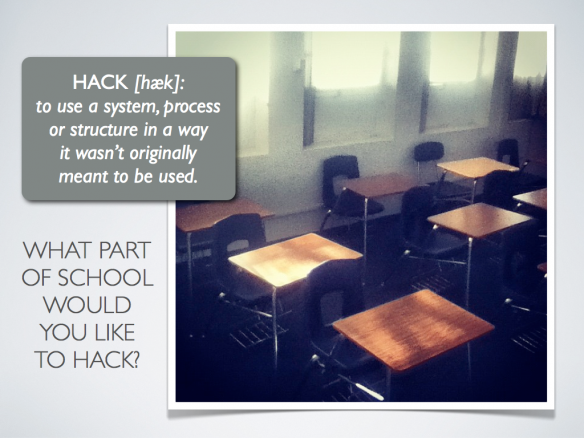
Hacking School #mschat

This week’s topic for #mschat is “hacking school!” Thursday May 9 at 8 pm ET.

From John T Spencer from here
The idea is not mine. Nicholas Provenzano, exposed me to the idea when he shared his visual writing prompts for blogging during the MACUL conference in March. Nick shared how he used this prompt with his high school English students. I felt it was a great way to hear the students voice.
Recently, I used the prompt with one of my classes. My middle school students loved the idea of “hacking” school. I shared my ideas about having flexible classrooms, 1:1 technology for students and more individualized instruction. My students took to blogging. I was anxious for the results.
Few of my middle school students took my lead for finding better ways to learn. Most students focused on different kinds of changes. Many wanted different food in the cafeteria. I totally agree here, but the food they desired to replace “school food” contained less nutritional content. Many wanted Taco Bell or McDonald’s to come in an cater. Some students desired vending machines with “pop and candy”. Change is needed for sure, more instruction in nutrition will be coming shortly.
As I moved past the “food changes”. Many post desired a change in the dress code, to no code at all. I asked, “What you want people showing up in underwear?” “NO!!” was the quick reply but students felt that nobody should control what they wear. Our school has a pretty lax dress code. I guess teachers need to share dress standards for different work environments.
Other students voiced their desire for a shorter school year, stating that more learning would occur. How this would be accomplished was not share. As I keep searching for hacks that would improve learning, I started to feel despair. Did my student feel their learning environments were satisfactory in our school? I feel changes could be made to improve learning, shouldn’t they?
As I dug deeper, I found specks of brilliance . One student wrote, “Schedules need to be flexible so student can choose the class order and lunch time based on desire and need.” Now that makes sense, why can’t it occur? Attendance and class size might be limiting factors but with work it can occur. Another talked about allowing students to use their technology for learning with a WiFi network. A student was clearly articulating a BYOD policy.
My students seemed focused on simple rule changes that might not make our school a better learning environment. Student voice is important to listen to when making changes. I feel that listening to it can also show educators knowledge deficits that need to be addressed in our students.
Teachers have seen education from many angles.I hope that by chatting with middle school educators about how to change schools. I can present a complete list of ideas before conquering this assignment with my students again.
If you have ideas about how to change schools to create better learning environments, please join #mschat on Thursday.

Layers of Atmosphere R.A.F.T. Writing

As we continue the study of weather in my classroom, Last week my students tackled the following assignment:

Learning Target: Understand layers of the atmosphere by writing a first person narrative.

R.A.F.T. Writing Atmosphere

R: Role– An experienced Space Shuttle Astronaut

A: Audience– The newbie on the flight

F: Format– Narrative

T: Topic – Describing what the newbie is seeing out the window as the space shuttle flies up through the layers of our atmosphere.

Assignment: You are to use the RAFT writing strategy to describe layers of the atmosphere. Give a vivid account of what of the layers of the atmosphere look like as you pass through them. Below is a checklist of what must be included in your descriptive  narrative.

  1. 4 –layers of the atmosphere
  2. At least 3– details about each layer
    1. Density
    2. Temperature
    3. Air pressure
    4. Composition
    5. Interaction with solar radiation
    6. Weather

3. 1 item you might see out the window in each layer

4.  At least 10 Content area words

5.Paragraph structure

6. Good transitions.

I felt this was a good way to have the students show their understanding in a creative way. I did not want the student just to recite the information found on websites or the textbook. We spend 3 class periods going over the layers of the atmosphere and planned on using this writing assignment as an assessment to check for understanding. I knew this image was stuck in many of my students heads:

layers-of-atmosphere-2-1cbdrpg.jpg (249×202)

After giving the assignment, I imagined reading some creative stories, lacking scientific details. (Know that is what typically happens on creative assignments.) Instead, I read dry regurgitation after regurgitation of atmospheric facts. I was surprised at the lack of creativity from my class as a whole. A few shining examples showed up here and there. Many skipped over the Role and Audience aspects of the assignment altogether. After spending two evenings frustrated with the results, I asked myself what went wrong? I returned to my classroom and represented the assignment. Asking why many had difficulty?

The response was obvious when given. “No mentor text” or ” I didn’t know what to do without an example”. Opps! It was on me. The teacher changed how the writing lessons works and students fell flat on their faces. All of the writing assignments for the weather unit, I had utilized a “mentor” text  to assist the students in creating high quality work. Up until this R.A.F.T. assignment, the majority of my students were writing with success. Now, in the absence the majority of students were having difficulty. After this lesson, I ask myself a few questions:

DO middle school students need mentor texts?

If mentor texts lead to success, should they always be used?

Are mentor texts a tool for success or give too much assistance with developing high quality writing?

I don’t have the answers, but it was very eye opening when looking at this lesson.

Classifying and connecting vocabulary

My goal in teaching is to have my students USE the knowledge that they learn in my classroom. So often, I see the students learn things for a quiz or test then totally forget what they learned. The knowledge was stored in their short-term memory for just as long as they needed it then it flies out of their ears ten times faster than it went in. After frequent discussions with a special education reading specialist, I have decided I need to use the vocabulary in different ways everyday during the unit of study. Forcing the students to see relevance of the vocabulary and use the terms frequently in writing and discussions.

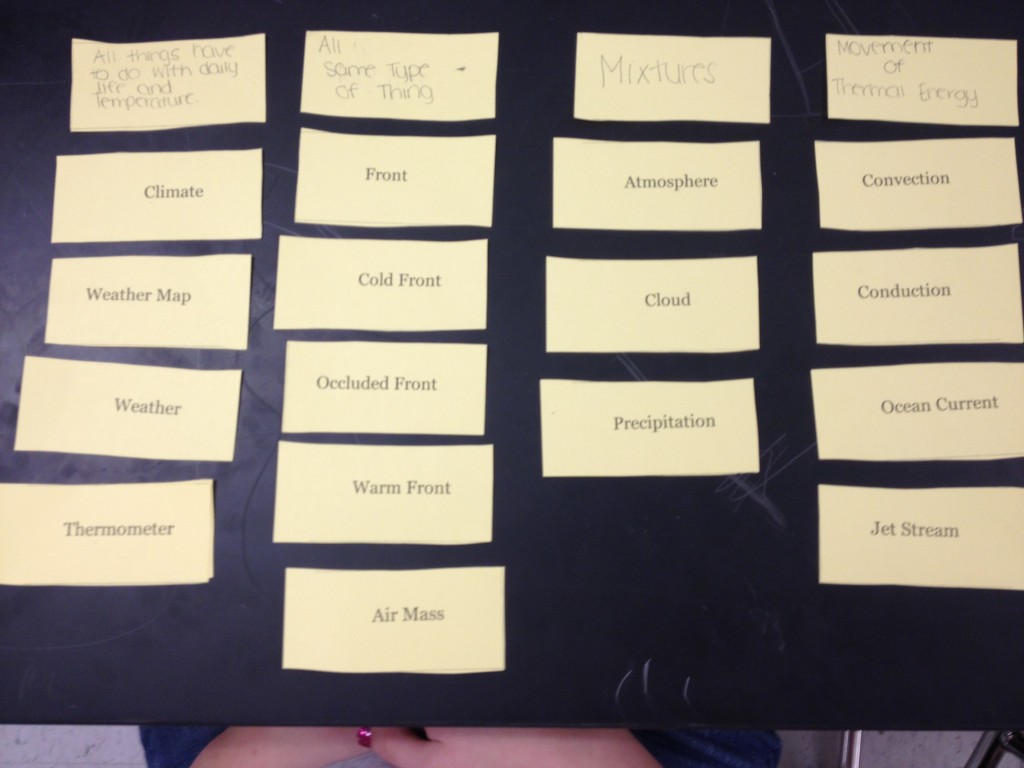
Yesterday, my science classes took 16 of our most frequently used vocabulary terms and classified them into groups. All the terms come from our weather unit. For these assignment there is no correct answer as long as the classification fits all items in the group. As I walked around the classroom, at first it appeared the student really knew what they were doing. I noticed many groupings that seemed to fit the assignment. As I started questioning the students about why and how the terms were grouped, I noticed a lack of deeper understanding. Many stated, “They just go together” or “I saw them on the same page as in the textbook.” I was glad they open the book to try to figure out the answer, but I gave this assignment because the answers aren’t in the book! As I kept questioning students, I noticed frustration creep into my classroom. My students really never thought about WHY terms could be grouped together.

We needed a quick lesson in grouping. I turned on the ELMO and placed a pen and pencil under the camera. I asked, “How can these 2 items be grouped?” Instantly hands shoot up in the classroom. “Writing utensils” was the first answer from the class. “What else could we add to this group?” I inquired. “Paper” was shouted out before I was done asking the question. “Does that fit class?” was followed by a chorus of “NO”. “So why not?” As the class worked through the explanation that paper is not used to write with but to write on, I saw a few light bulbs light up. Groups quickly went back to work on the classifications.  Below are a couple of results from class:

As class wound down, I noticed a few students were still struggling with classifying their terms. I started planning on the fly for the next day. In order for students to classify the terms they need to understand how the terms are connected. Does one concept cause the other? Are they similar? DO they require similar conditions? I decided that the students needed to write about the connections in their KidsBlog.org  accounts.

Here is the assignment:

I want you to write about how at least 4 words from our vocabulary that  work together to affect/cause/produce our large topic of weather. See the mentor text below for an example:

Mentor Text:

Connected words: Conduction- Convection-Jet Stream – Ocean Currents

The sun transfers energy to the Earth by radiation, conduction and convectionConduction occurs when the sun lights energy is directly transferred by contacting a surface on Earth. Convection occurs due to uneven heating of the surface, which creates movement from warm areas to cooler areas.  Due to these two methods of transferring the sun’s energy, water and air move. The jet stream is a high-altitude wind caused by the suns energy. Ocean currents are steady one directional flows of water also caused by the energy from the sun. Conduction and convection are methods for transferring energy to cause the jet stream and ocean currents.

As we entered the computer lab, I hoped for this assignment to help the students gain a better understanding of their vocabulary. While, I was presenting the task to the class, a couple of students raised their hands and shared how they felt the words are connected. For the second day, I explained that there were no right or wrong answers. All of the words  deal with weather so they are all interconnected in different ways. Students just needed to talk about how the terms go together. Below are a few examples of student work:


Warm fronts and cold fronts can cause warmer or colder temperatures you can use a thermometer to find the exact temperature. Occluded fronts  are also caused which are a form weather. Rain, snow, sleet and hail are all forms precipitation which fall from clouds. You can find the climate by averaging the weather.

The sun gives off energy through radiation throughout the universe. When the radiation nears the Earth, it must first reach the atmosphere. The amount of energy that gets through the atmosphere, winds, clouds (tiny of millions of water droplets or ice crystals), is the weather, (the conditions of the atmosphere in a given place and time). The weather tends to change similarly each year, and can always change whether we can predict it or not. This is the main  difference between weather and climate (the weather in some location averaged over a long period of time). The climate also deals with weather, such as temperatures, precipitation, etc… All of these rely on the sun for energy, the atmosphere to suppress (absorb) some of the energy such as harmful ultraviolet rays, for their ability to do their job and for us to simply be.


The sun transfers its energy to the earth by radiationconduction is when the suns energy s directly hitting a spot on the earth, convection is when the suns energy unevenly hits the earths surface causing that spot to move from cold to hot, do to this it creates wind and ocean currents. The jet stream is a wind in high altitude caused by the suns energy. Ocean currents are flows of water caused by the suns energy that move in one direction due to wind. All of these words are a way of transferring energy. in this case they all transfer energy that’s from the sun.


 As I walked around the room, these responses showed me that the students we finally connecting themselves to understanding their vocabulary. I feel that students benefit from spending time using terms they need to know. Teachers have to get past having student write a definition! Student need to see the terms in context and use them in a connected manner to clearly communicate their learning. I can not be more proud of my students and their learning today.

#MSchat 4-18-13 #CCSS

Tonight we had a lively discussion about the Common Core State Standards. We started off talking about the limited amount of training many teachers have had for the change. I lead to a great debate about teaching reading and writing across the curriculum. Very informative discussion. Below is the link to the archive.


[View the story “#MSchat 4-18-13 CCSS” on Storify]

Learning Vocabulary with Metaphors

Today I used the following assignment in my science classroom:

The Learning target for today is to demonstrate understanding of vocabulary through the use of Metaphoric representation.

Part 1: Required- Vocab Metaphors

  • Pick 4 of our vocabulary words from our vocab list
  • Find a “non-scientific” picture that represents the word – Like we did yesterday in class
  • Explain why the picture represents the word

Click here to go to Quizlet to review vocabulary.

Go here to write your Vocabulary Metaphors in your  Kidblog.org.

Mentor Text for a 4

An ocean current is a continuous, directed movement of ocean water generated by the forces acting

When I read that definition I began to think about my advisory students who are preparing for the NWEA test.  To help them improve their math scores I am bringing them in the computer lab to review.  I feel like this test is like an ocean current because it is directing the path of education.   The direction of education is currently moving to align more and more with the tests.  Teachers and students are under great ”forces” to be successful.   Ocean currents are controlling the flow of water and tests are controlling education.

Mentor Text for a 3

Title: Vocab Metaphors

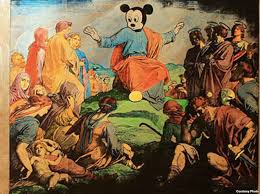
Vocabulary word: Front –  the atmospheric phenomenon created at the boundary between two different air masses

This image represents front because the Mickey Mouse character is a boundary between the two different masses of people.  Also the Mickey Mouse looks like he in the atmosphere. This connects to the vocabulary word because “Front” is a boundary between two masses of air.

________________________________________________________________________

The mentor texts are present to model for the students the quality of writing that is expected  in their blog posts. The use of Metaphors to connect to vocabulary was modeled in my classroom yesterday with the help of our wonderful, special education teacher, Mrs Hogan.

Many of my students are struggling to meet the criteria for success on this assignment. It is not that they can’t define the words, or use pictures to connect to the words, but because the students are concrete thinkers. My students struggle with the idea of a metaphor. When they want to be literal in the representation with a picture. Look at the following example for the word “Climate”

                  CLIMATE: the climate in the desert  stays the same all the time.

A picture of a desert climate to be a metaphor for climate? The picture does represent a climate but not metaphorically. I need to figure out how to engage the students at a higher level of thinking to create metaphors instead of literal representation.

As I continued to see literal representation after literal representation, I asked the class to reexamine the “mentor” texts. Ask themselves if they were following the model laid out before them. Many were upset. They acknowledge that the model was not being followed accurately. I stated that “It is okay to make a mistake, it is not okay to leave the mistake uncorrected after realizing it is a mistake.”  Student went back to work and created samples that looked more like this:

Ocean Current: The steady flow of surface ocean water in a prevailing direction.

This image of a highway is like an ocean current because the movement is continuous.

and

Atmosphere – is a mix of gases that surround the Earth. When I think of the atmosphere I think of salad, because salads are always mixed with something, weather it’s salad dressing, fruits and vegetables, etc.

Students need constant reminders of expectations. When expectations are not met teachers need to guide students back to the goal of the learning activity. Teachers need to point the students towards high quality examples of work. Allow the students to assess their own work and give them time to make the necessary changes. Students seem to rush into assignments with the desire of completion. Monitoring needs to occur to make sure learning targets are achieved.