
Reflective Teaching Challenge Days 1-2 Goals and Tech

20140902-191122-69082921.jpg

I started blogging two years ago as a tool for me to track my reflections on teaching and learning. I felt I needed an outlet for me to release all the thoughts swimming in my head and limiting the amount of sleep my body received. It has been a great journey. This morning Rachelle Wynkoop shared, Reflective Teaching: 30-day blogging challenge for teachers. My first thought was I am too busy and a day late to get going on the challenge. An easy cop out! Rachelle encouraged with a quick tweet saying “Keep it simple, no need to stress!” Followed by a link to her post for day 1. After taking the day to teach and reflect. I really need to take up this challenge. If I don’t have time for quick reflections, I should not be teaching. I need to take at least 10-15 minutes a day to reflect. Thanks to one of my great #michED friends to push me just enough to take action. That is what friends are for!! SO here goes my reflections for day 1 and 2 of the challenge:

Day 1: Goals

Starting the year without goals is like going on a trip without a map or destination. Must have goals in mind every day when teaching.

Goal 1: Put students in charge of their learning: My job is to show the learning objective, give options of how to get there and get out of the way until a students is stuck on the journey. 

Goal 2: Give the classroom to the students: Let them control the learning environment and set the classroom expectations 
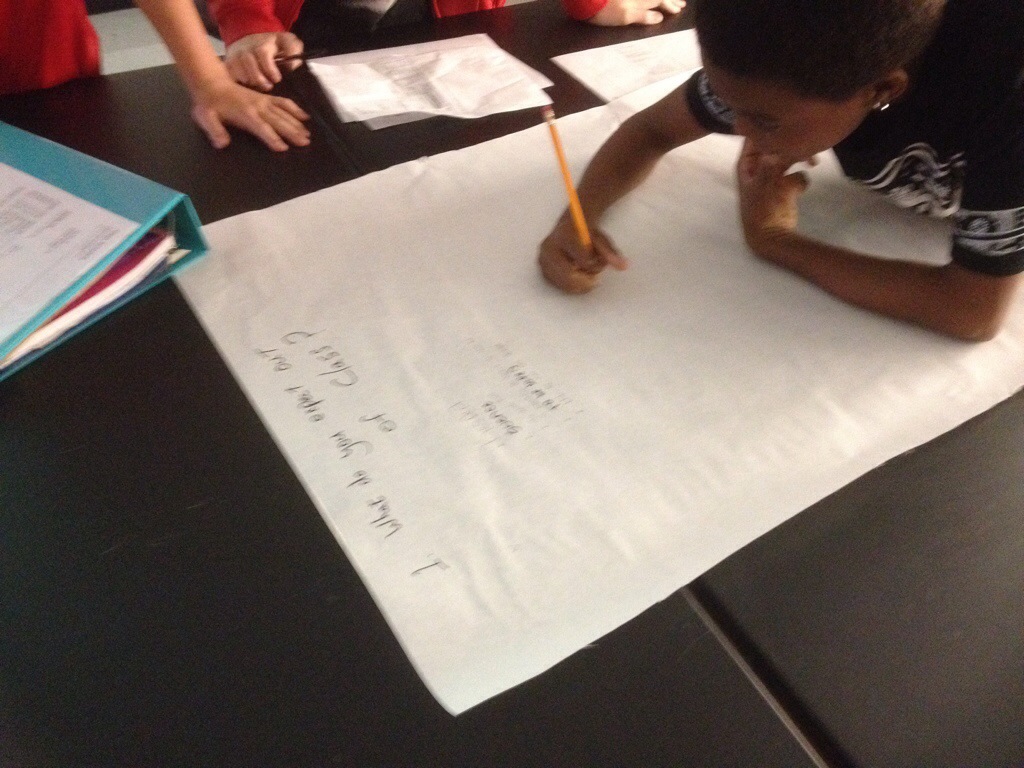
20140902-191125-69085194.jpg

Student writing learning expectations for class.

3. Check my emotions and stay positive: Learning happens best when the environment is positive. I need to focus on the positive and not get drawn into the negative that surrounds educations. Focus on what the students learn, not what they don’t, live the mantra: First Attempt In Learning. In the past failures have effected my teaching and classroom, I can’t let it happen. Focus on process not product.

Day 2: Technology Integration

Using Remind with purpose! I have used remind (remind101) in the past but not with a true learning purpose. Using it to remind parents of tests and project is just the tech version of a note home in the agenda. I need to be more productive with the use of remind. I plan on sending out at least 2 weekly messages. First one will include and overview of the week’s learning targets and the second on containing the week’s vocabulary. This will make an electronic recording of learning for each week of the year. Students can look back at messages to see what was covered to review for quizzes and tests. I hope this more deliberate use of an incredible tool will help learning in my classroom. 

Since my goal is for students to own their learning, I also hope to build the capacity in my students so that they will eventually be the ones sending the messages to themselves. I feel handing control over to the students give the messages more meaning and purpose. After I have tried this I hope to blog more about how it works for me in my classroom. 


ALS Ice-bucket Challenge and Education

Yes, I am one of thousands perhaps millions of people who have taken the ALS ice-bucket challenge. ALS is a devastating disease that that attacks people in the prime of their lives, most notably Lou Gehrig. The ALS association has been around for years advocating for research and raising funds. Now thanks to the phenomenon that is “ALS ICEBUCKET Challenge”. 8- weeks of viral success has finally accomplished, what years of advocacy could not. Record fund raising and new found awareness for the disease.


What does this mean for education and educators?

First: To get a message across it has to be repeated in a crazy and challenging way. ALS has been around for a long time, It wasn’t talked about in the main stream until recently. Many of the bucket dumpers had little knowledge about ALS until this challenge was covered in the mass media. This David Burgess got it right in Teach Like a Pirate: Hooks draw people in and make them want to learn.

Second: It has to be cool for people to want to do it. The challenge did not really take off till the “COOL” people were doing it. If I was the only one dumping frozen water on may head few would follow, most would laugh and say I was nuts. When celebrities help the challenge take off. When can we get their help in making learning cool? Because it really is cool to know stuff.

Third: Learners make learning their own. Very few challenge videos look the same. Everyone has a different rendition. Some are awesome and some fail. Many in between. Key is learning is personal we want to OWN it. Teachers need to allow students to learn and express learning in their own way.

I am happy ALS is getting its due time in the spotlight. It is awesome that it has raised over 30 million dollars to date, sadly that is less than the coast of one F-16 for our military. Hopefully in the future there will be a viral campaign the makes education as cool as dumping ice water on our heads.

Please give to ALS research, help pick up trash in your neighborhood, make our world a better place to live. This is the message to all of us from the Ice bucket challenge.

The Value of EdShelf #SaveEdShelf

Have you heard of “EdShelf”? I hadn’t either, until recently. I saw a tweet from a fellow educator promoting the hashtag #SaveEdShelf. It promoted my interest. What was this site? Why should I help save it?

I visited the site http://www.edshelf.com to see what all the buzz was about. EdShelf is a socially curated directory of educational resources. As I explored the site, I found it to be an amazing resource. Since I started teaching I have been looking for a one stop location to find resources for teaching. EdShelf is just that. It gives links to thousands of tool along with peer review. Where has this site been hiding? Obviously EdShelf is a valuable small budget start up. Many tools start this way, just ask Remind and Edmodo. EdShelf has just struggled to take hold.

A few days latter I included EdSelf in a presentation to a group of connected educators. Nobody in the room had hear of it. When I explained the value, many were eager to learn more. Educators and School districts have very tight budgets. EdShelf is a wonderful tool to help us use our limited funds wisely. Instead of a flashy sales pitch from a vendor looking for a contract, EdShelf provides review of tools by teachers who are using them, listing pros and cons sales teams often fail to notice. 

Now EdShelf needs our help. This FREE service is running out of revenue to stay afloat. This hidden gem for educators needs to stay around. I value the service so I am helping fund their KickStarter Project. Please help if you can. Their campaign ends soon. I urge you to check it out and if you can afford to help Please do! Thanks in advance. 

Reading Attitudes


The-Art-of-Reading

I have been lucky. My parents instilled positive reading positive reading attitudes in my life ever since I could pick up a picture book. My mother was a teacher before she had children. I was lucky that my father had enough money made enough money so my mother could stay home with us when we were little. She read to us every day. We constantly went to the local library to attend children’s readings and to pick out new books to read. Growing up I had little exposure to television. We did not get cable until I was away at high school. Our summers were spent at a  cottage in northern Michigan where a television was not even present. This lack of television  created a need for other forms of entertainment. My parents encouraged books as the means to fill free time or as an activity to fill a rainy day.

The most vivid memory of reading comes from when I was in first grade. We lived in Milwaukee, Wisconsin. The local NBA basketball team sponsored a youth reading program. The students who read the most books would receive tickets to a game. I remember reading tow or three books a day hoping to win tickets. I believe the program was “Bucks Love Books!” I was competing against my older brother. We raced through each stack of books that we brought home from the library. We ended up in a tie, most likely orchestrated by mom. I know I read over one hundred books and received tickets to a game. We went to the basketball game together with a since of pride for earning the tickets.

My family has always encouraged reading. My grandmother, who was legally blind for the last 30 years of her life. Enjoyed reading and listening to books till her death last year. When ever we would talk, she would ask questions about what I was reading or had read lately. She used to give books as presents for birthdays and Christmas. My family has done a terrific job of modeling reading habits. Even after my  parents gave in to their children’s plea to purchase cable, they still set strict guidelines and hour limitations for its use. With these restrictions they forced reading upon me. I am forever thankful. Even though I did not enjoy being forced to read.

I plan on being a positive role model for my students and children. I will use references to literature in my lessons. By using these references my students might be encouraged to read for more understanding of the references. I realize most parents are not like mine. Many children come home today to a empty house. They have the freedom to turn on the television any time for entertainment. I hope to set up an after school reading program wherever I teach. This program will be for students as an alternative to going to a empty house.

Hopefully I can encourage students to gain a love for books. There are so many wonderful bools written each year that should be read by everyone. I feel that due to the increasing popularity of television, on-demand video and the internet reading books has declined. It would be a shame if the quality of books deteriorates. Students need to realize that all of the material on the web and television is also available at the corner bookstore.

*** Originally Written in 1998 for my Teaching Reading Class Eng 308 @GVSU for Professor Jill Warren. (with some updates)

Good to reflect on learning so many years later. Need to start up that reading program!


Why Do I Teach?

I was pursuing twitter this morning, following all the wonderful Michigan conferences that I am missing, when I ran across a tweet from my friend, Michael Medvinsky. Michael was at home following the #zetacon hashtag, when he was inspired to act by writing a blog post and recording a video. Kevin Honeycutt was delivering the Keynote at Zetacon and asked “Why do you teach?” This is a very important questions for educators. Most of the time we share ideas about how we teach. Most conference focus on Pedagogy and “best practices”. Rarely do we hear teachers share their WHYS for teaching. Often without knowing why people do what they do we have a disconnect and fail to appreciate their work.

I know the why is often a long complex story. It is never the public assumption as to why teachers teach. “Teachers teach for the summers off, the benefits and 9-3 jobs.” Teachers need to share their WHYS so we get past the assumptions and focus on the reality. As schools across the country kick off the 2014-2015 school year teachers need to reflect on why we teach. I would like to say want to inspire and change the world, but there is so much more to why I teach. Here is a short video I made:

I know I missed some of my great inspirational teachers especially Jack Ridl from Hope College.

Please reflect on WHY you teach. I hope you can share your story with me by either posting a comment on the blog or creating your own video on using the hashtag #iTeach on twitter.

Have a great 2014-2015 school year. Always remember WHY you are doing what you do. Thanks Kevin and Michael for the inspirational reminder.

Rethinking Recess


Since our five year old twins are preparing for their kindergarten year, my wife asked our soon to be fifth grader about the kindergarten schedule. Griffin is a school safety in the kindergarten rooms and pays attention to details. When the topic of recess came up he said, “When the classes are behaving they have recess after lunch and a recess later in the day.”  From 9 AM to 4 PM a group of five year-olds only has two unstructured play times? I am a bit worried.

We need to rethink recess! We need more! Why?

“Play is the only way the highest intelligence of humankind can unfold.” -Joseph Chilton Pearce

I know that excellent kindergarten teachers incorporate play into their lessons and give the students time to explore their learning in class. How can teachers take this to the next level? Here are a few ideas teachers should explore:

1. Unscheduled recesses: Why do schools assume ALL of a certain grade are ready for recess at the same time everyday. When a class is ready for recess the teacher can tell. They shouldn’t have to wait. Just go out and enjoy the break. It can be shorter or longer than the prescribed times published in the school schedule.

2: When class is misbehaving or off task, time for a recess: Student misbehave for a recess, usually it is due to boredom or too much time on task. David Garcia said ” kids need unstructured Time, when’s the last time you were comfortable in a 5 hour flight?” Classes need to design breaks and movement so that students don’t feel they are trapped in the plane of education all day. Going outside with unstructured time provides this for them. Having a bad back, I can’t sit much longer than 30 minutes, similar to many of our students.

3. Remember that recess is a NEED for our students not a privilege. Young students need to get outside and move. Making them sit inside as a punishment is only really a punishment on the teacher. Research shows that students will perform better the more they get out an move. Many teachers feel that that is for home, but we need to remember that most students spend too much time in front of a screen at home than playing outside. So fulfill the need in school. Please don’t take away this time as a punishment.

Let’s rethink recess for the good of our students’ learning!